


Non‑mention of Wife in Will Indicates Undue Influence; Will Held Vitiated
 Copy Link
 Share
 Save

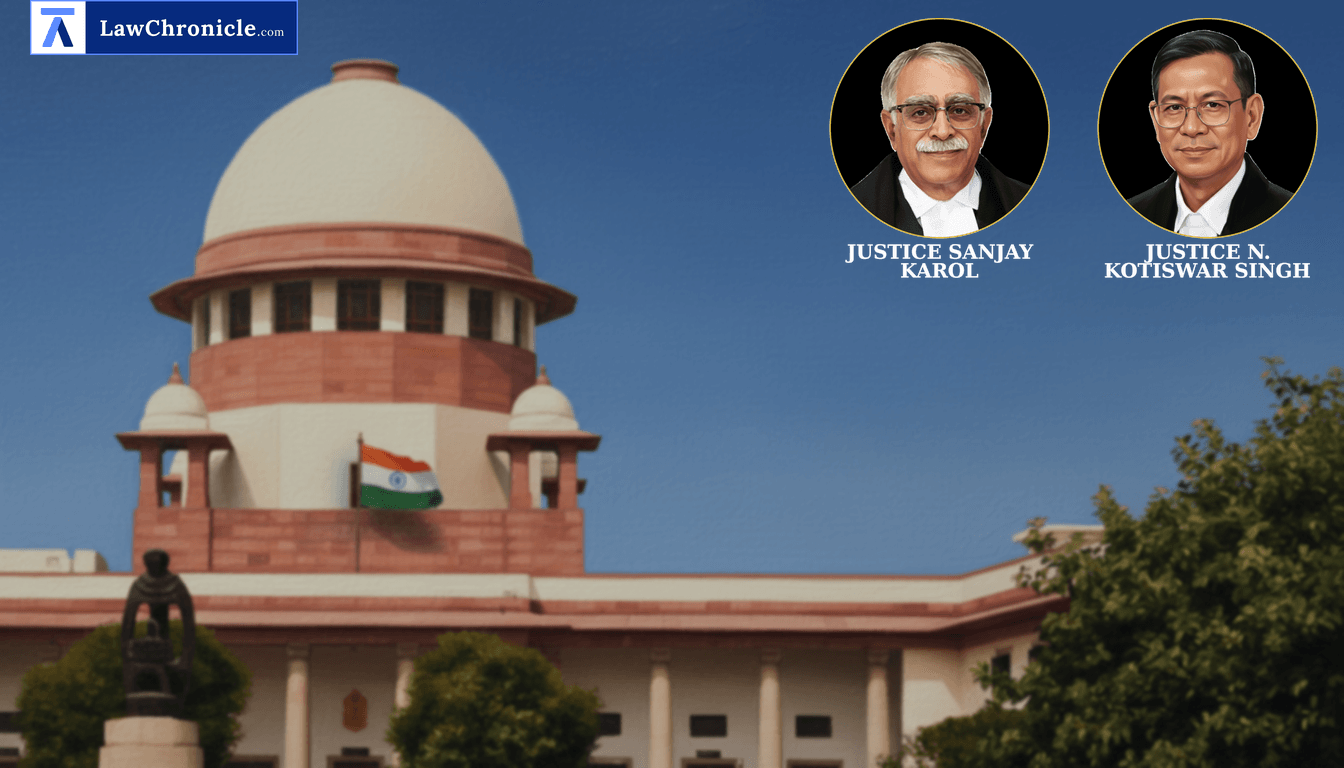
A Bench of Justices Sanjay Karol and Joymalya Bagchi heard appeals challenging the Punjab & Haryana High Court’s decision that set aside concurrent findings of the trial and first appellate courts and declared the respondent owner and in possession of the suit land. The appeals arose from a probate and title dispute in which a registered Will dated 16.05.1991, propounded by the appellant in his favour, was impugned on the ground that it omitted mention of the testator’s wife and gave no reason for her disinheritance.
The Court upheld the High Court and dismissed the appeals, holding that the cumulative circumstances surrounding the Will, including the complete omission of the testator’s wife and absence of any explanation for her exclusion, created a grave suspicion that the will was the product of undue influence. The Bench emphasised settled principles that when “suspicious circumstances” attend execution of a Will the propounder must dispel all reasonable doubts and satisfy the conscience of the court. The Court, in its reasoning, observed: "In this background, we have no hesitation to hold that non mention of 1st respondent or the reasons for her disinheritance in the Will, is an eloquent reminder that the free disposition of the testator was vitiated by the undue influence of the appellant." The judgment noted that proof of due execution and registration did not, by itself, dispel suspicion where the overall facts pointed to possible manipulation by the propounder.
Background
The suit land belonged to one Maya Singh. The appellant, Maya Singh’s nephew, propounded a registered Will dated 16.05.1991 bequeathing the property to him on the ground that he had cared for the testator. The principal respondents asserted that Jagir Kaur (1st respondent) was Maya Singh’s lawful wife and that Gurpal Singh (2nd respondent) was their adopted son. The trial court accepted the Will as genuine, declared the appellant owner, and rejected the respondents’ claim to adoption; it nonetheless recorded that the 1st respondent was the lawful wife. The first appellate court affirmed the trial court, finding signatures and registration unimpeached and observing no convincing proof of incapacity or collusion.
The High Court, on second appeal, framed the substantial question whether the Will had been duly proved and concluded that the “complete silence on the part of the executant qua his wife, while executing the Will, renders the will a suspicious document and leads to the inference that the same had not been executed by the executant of his free disposing mind.” The High Court held that the omission, read with other facts — the testator’s wife’s testimony that she lived with him till his death, the absence of evidence of a bitter marital relationship, and the propounder’s apparent motive to deny her status — impugned the Will’s authenticity.
On appeal to the Supreme Court, senior counsel for the appellant relied on formal proof: evidence of the scribe and an attesting witness, registration of the Will, and that the testator had earlier provided money and pension entitlements to the 1st respondent. Senior counsel for the respondents argued that the omission must be viewed against the totality of circumstances and that the propounder sought not merely to disinherit but to erase the wife’s very existence in the testamentary document.
The Supreme Court applied the established legal tests in wills jurisprudence — including that the existence of suspicious circumstances makes the initial onus on the propounder heavier and that the judicial conscience must be satisfied before a will shrouded in suspicion can be accepted. Citing precedents, the Court held that deprivation of a legal heir, though not conclusive, required cogent explanation when unexplained and when combined with other peculiar facts. Viewing the omission together with the appellant’s asserted motive and the surrounding evidence, the Court found undue influence and affirmed the High Court. The appeals were dismissed and pending applications were disposed of. No interim directions or liberties were recorded.
Case Details: Case No.: CIVIL APPEAL NO(s). 3509‑3510/2010 (Reported as 2025 INSC 866) Case Title: Gurdial Singh (Dead) through LR v. Jagir Kaur (Dead) and Anr. etc. Appearances: For the Petitioner(s): Mr. Manoj Swarup, Senior Counsel For the Respondent(s): Mr. Arun Bhardwaj, Senior Counsel
Similar Articles

 Breaking News


