


Patent Illegality and Perversity: Calcutta HC Sets Aside Arbitral Award Over Breach and Damages
 Copy Link
 Share
 Save
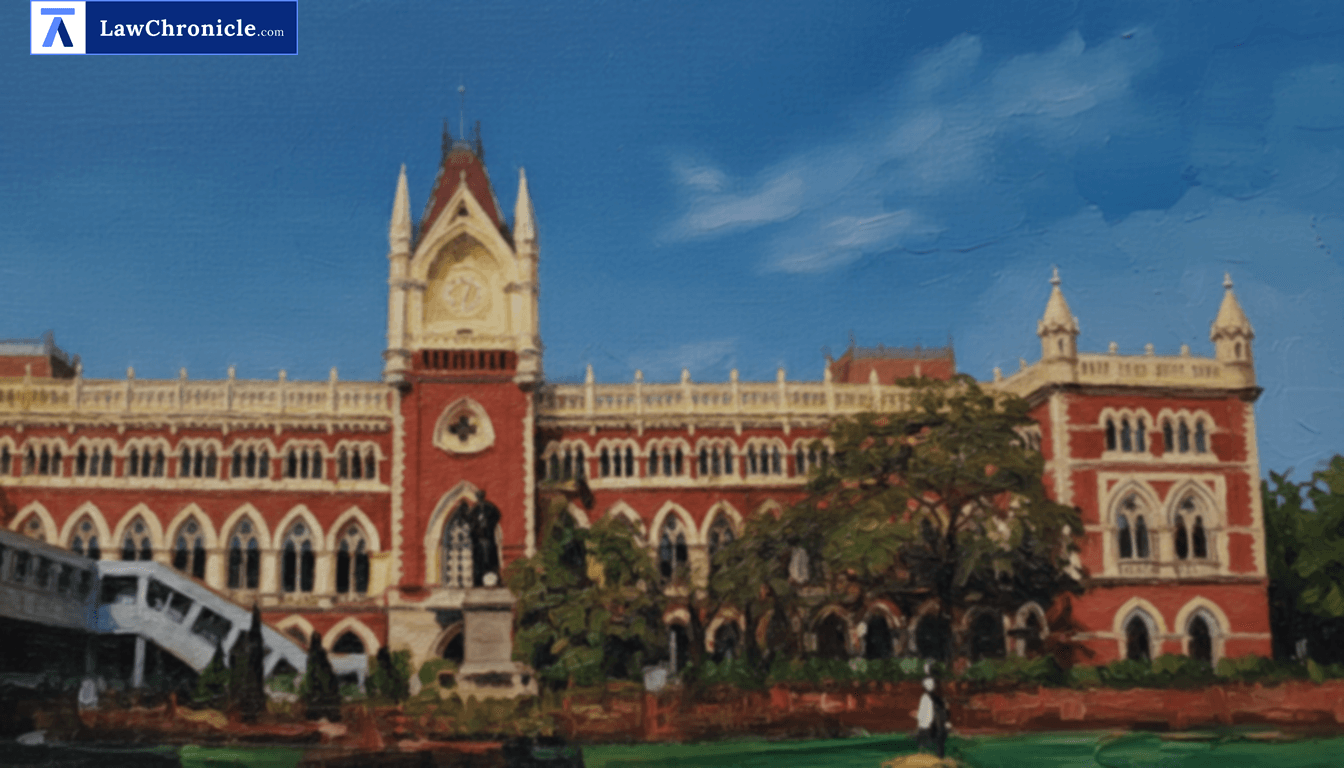
Arbitral awards that disregard contractual terms and award damages without evidentiary support constitute patent illegality, rendering them vulnerable to being set aside under the public policy of India. The Calcutta High Court has reinforced the boundaries of judicial interference in commercial disputes, emphasizing that while courts cannot re-appreciate evidence, they must strike down awards that are unintelligible, unreasoned, or contrary to substantive law.
A Division Bench comprising Justice Debangsu Basak and Justice Aryak Dutt delivered this judgment while hearing an appeal against a District Court's order that had set aside an arbitral award. The dispute originated from a Memorandum of Understanding for the construction of a market complex in Digha, which was terminated by the Digha Shankarpur Development Authority citing environmental norm discrepancies.
Key Takeaways
Contractual Supremacy Upheld
Arbitrators are bound by the specific terms of the contract under Section 28(3) of Arbitration and Conciliation Act, 1996, and failure to address fundamental contractual gaps, such as missing price rates, constitutes a patent illegality.
Evidence-Based Damages Mandatory
Loss of profit claims cannot be awarded based on inflexible mathematical formulas like 15% of the contract value; they must be supported by material evidence showing actual loss under Contract Act, 1872.
Scope of Section 34 and 37
While a court under Section 34 of Arbitration and Conciliation Act, 1996 cannot act as a court of appeal to re-appreciate expert evidence, it is duty-bound to set aside awards that ignore vital evidence or contain self-contradictory operative parts.
Court's Rationale on Patent Illegality
The Bench observed that the learned Arbitrator treated a Memorandum of Understanding (MOU) as a conventional works contract despite the per-stall rates being left blank in the document. The Court noted that the award failed to decide the dispute in accordance with the terms of the contract, which at the time was a mandatory requirement under Section 28(3) of Arbitration and Conciliation Act, 1996. The Court, in its reasoning, observed: "The award does not decide the dispute in accordance with the terms of the contract. An award that is silent on such a question is not reasoned... and is patently illegal for disregarding of Section 28(3) as it then stood."
Observations on Loss of Profit and Presumptive Awards
Regarding the award of loss of expected profit, the High Court criticized the reliance on A.T. Brij Paul Singh v. State of Gujarat as an inflexible rule. The Court held that damages under Section 73 of Contract Act, 1872 are intended to compensate for natural losses and are not a penalty. It further remarked that the Arbitrator's decision to "reasonably presume" unrealized advances without supporting cash books or material evidence was legally unsustainable.
The Court has following directions:
"The judgment and order dated 12th March, 2019, passed by the learned District Judge, Purba Medinipur in J. Misc. Case No. 23 of 2014 is set aside. The award dated 14th February, 2014 made by the learned Sole Arbitrator is set aside. The interim award for Rs. 15,00,000/-, made on consent of the parties and since paid, was not the subject of the challenge under Section 34 and is not affected by this judgment. The appeal, AO-COM/40/2026, is thus disposed of accordingly."
Ratio
An arbitral award that ignores the specific terms of the agreement, relies on presumptions instead of evidence for quantifying damages, or contains internal contradictions between its findings and the operative part, is patently illegal and perverse, necessitating its setting aside in entirety under Section 34 of the Arbitration and Conciliation Act, 1996.
Background
The appellant, a co-operative society, entered into an MOU with the Digha Shankarpur Development Authority (DSDA) in 2004 to build a market complex. However, DSDA suspended and eventually cancelled the MOU in 2005, citing the lack of environmental clearances and Coastal Regulation Zone (CRZ) norms. The appellant invoked arbitration, leading to an award in 2014 that held the termination illegal and awarded various sums, including substantial damages for loss of profit.
DSDA challenged this award under Section 34 of Arbitration and Conciliation Act, 1996. The District Judge set aside the award by re-evaluating an expert report and relying on documents not present in the arbitral record. While the High Court found the District Judge's method of re-appreciating evidence flawed, it ultimately agreed that the award itself was legally unsustainable. The High Court applied the principles laid down in Associate Builders v. Delhi Development Authority ( "(2015) 3 SCC 49": 2014 CaseBase(SC) 661), Oil and Natural Gas Corporation Ltd. v. Saw Pipes Ltd. ( "(2003) 5 SCC 705": 2003 CaseBase(SC) 76), and Oil and Natural Gas Corporation Ltd. v. Western Geco International Ltd. ( "(2014) 9 SCC 263": 2014 CaseBase(SC) 386), concluding that the Arbitrator’s failure to consider the "quasi-contractual" nature of the MOU and the lack of evidence for profit loss rendered the award perverse.
Case Details:
Case No.: AO-COM NO. 40 of 2026
Neutral Citation: 2026:CHC-AS:1726-DB
Case Title: Friends Engineering Co-operative Society Limited Vs. Digha Shankarpur Development Authority
Appearances:
For the Petitioner(s): Mr. Debashis Kundu, Sr. Adv., Mr. Indranil Nandi, Mr. D.P. Samanta, Mr. Sayak Konar
For the Respondent(s): Mr. Surojit Nath Mitra, Ld. A. G., Mr. N.C. Bihani, Sr. Adv., Mr. Soumya Mukherjee, Mr. Dibashis Basu, Ld. A.G.P., Ms. Sneha Dutta, Mr. Purnendu Das
Source: 2026 CaseBase(CAL) 2933
Similar Articles

 Breaking News


