


Registered Documents Carry Formidable Presumption of Validity: Himachal Pradesh HC
 Copy Link
 Share
 Save
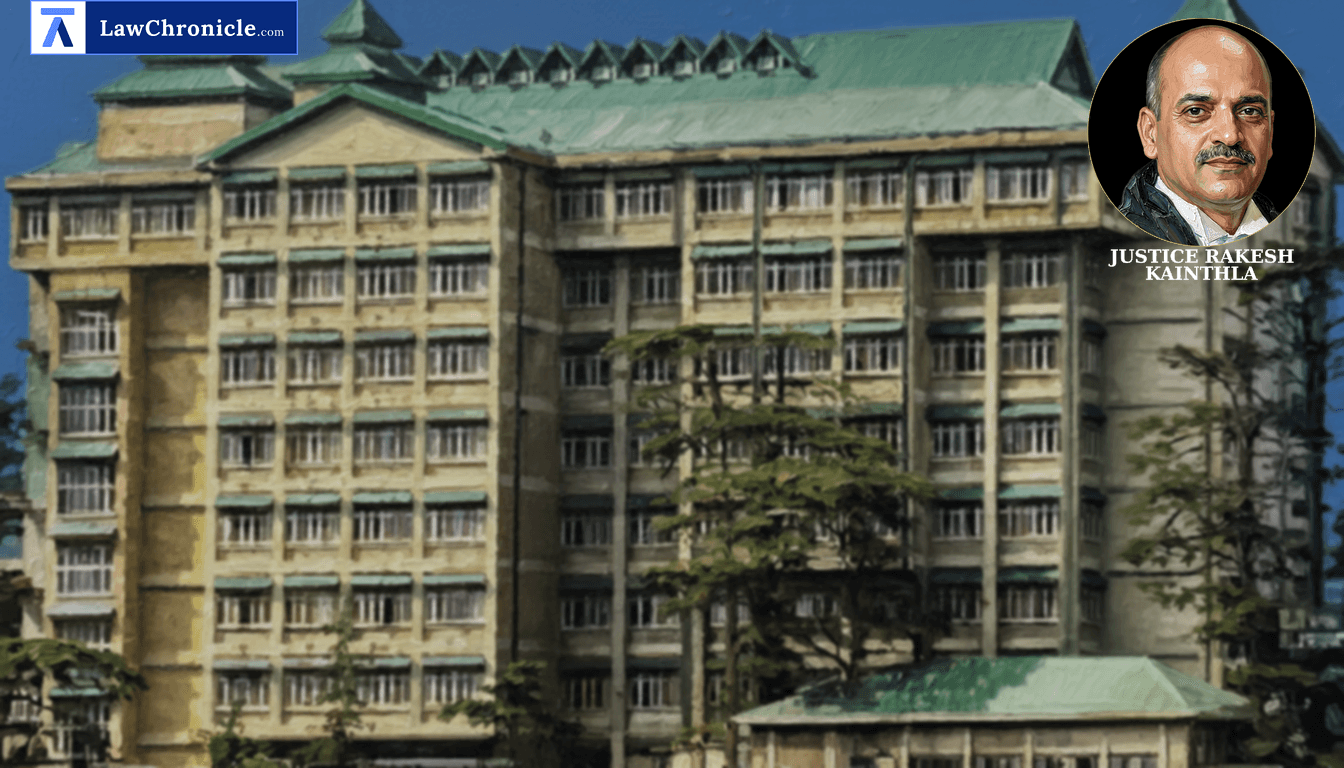
In a decisive reinforcement of the sanctity of registered instruments, the Himachal Pradesh High Court has ruled that a registered deed carries a formidable presumption of validity that cannot be casually displaced by frivolous allegations of fraud. The Court held that unless a challenger provides material particulars and cogent evidence to demonstrate that a deed was never intended to operate as a bona fide transfer, the judicial conscience must uphold the certainty of registered property transactions.
Justice Rakesh Kainthla presided over the second appeal, which challenged a First Appellate Court's decision to set aside a Trial Court judgment regarding a disputed General Power of Attorney and a subsequent Will. The matter originated from a suit seeking to declare a sale deed and a Will executed by the late Rajo Devi as null and void based on allegations of fraud.
Key Takeaways
- Sanctity of Registration Strengthened
Courts cannot declare a registered document a 'sham' at the drop of a hat, ensuring public confidence in property transactions remains intact. - Heavier Burden on Challengers
Parties alleging fraud or misrepresentation in registered deeds must meet a high threshold of proof beyond reasonable doubt to rebut the statutory presumption under Section 60 of the Registration Act, 1908. - Legal Heirs' Right to Challenge Stays
The Court affirmed that the right to avoid a contract procured by fraud is exercisable by a party's legal representatives under Sections 19 and 19A of the Indian Contract Act, 1872. - Equality in Testamentary Disposition
An unequal distribution of property among children does not automatically constitute a suspicious circumstance if a valid explanation, such as a prior gift deed, is evident.
Presumption of Validity Under the Registration Act
The High Court emphasized that under Section 60(2) of the Registration Act, 1908, there is a presumption that a registered document was validly executed and its contents were explained to the executant. The Court noted that this presumption becomes even more significant when the executant did not challenge the document during their lifetime.
The Court, in its reasoning, observed: "It is a settled position of law that a registered Sale Deed carries with it a formidable presumption of validity and genuineness. Registration is not a mere procedural formality but a solemn act that imparts a high degree of sanctity to the document. Consequently, a Court must not lightly or casually declare a registered instrument as a “sham”. The burden of proof to displace this presumption rests heavily upon the challenger. Such a challenge can only be sustained if the party provides material particulars and cogent evidence to demonstrate that the Deed was never intended to operate as a bona fide transfer of title."
Role of First Appellate Courts in Reversing Findings
The Bench highlighted a procedural lapse in the First Appellate Court's judgment, noting that it failed to come to 'close quarters' with the reasoning of the Trial Court. Citing Somakka v. K.P. Basavaraj and Santosh Hazari Vs. Purushottam Tiwari (dead) through LRS, the Court reiterated that an appellate court must assign specific reasons for arriving at a different finding when reversing a judgment of fact.
The Court has following directions:
"In view of the above, the present appeal is allowed; the judgment and decree passed by learned Appellate Court are ordered to be set aside and those of learned Trial Court are ordered to be restored. Pending application(s), if any, also stand(s) disposed of. Records of the learned Courts below be sent down forthwith."
Ratio
A registered document is prima facie valid in law, and the initial onus lies heavily on the party challenging its genuineness to prove fraud, misrepresentation, or lack of capacity through cogent evidence. Allegations of suspicious circumstances regarding a Will must be specifically pleaded and proved at the trial stage and cannot be raised for the first time during an appeal. Furthermore, non-payment of sale consideration at the time of execution does not, by itself, invalidate a registered sale deed.
Background
The litigation began when the plaintiff challenged a General Power of Attorney executed by his mother, Rajo Devi, in favor of his brother (Defendant No. 1). The plaintiff alleged that this Power of Attorney was obtained through fraud and that the subsequent sale of the suit land to a brother-in-law was a sham. Furthermore, the plaintiff contested a Will dated September 26, 1990, which favored the defendant, claiming his own Will dated June 21, 1990, was the valid one.
The Trial Court had dismissed the suit, finding that the defendant had served the mother and that the Will was meant to equalize property since the plaintiff had already received a gift of 28 kanals. However, the First Appellate Court reversed this, citing 'suspicious circumstances' and fraud. The High Court, applying Code of Civil Procedure, 1908, Indian Succession Act, 1925, and Indian Evidence Act, 1872, restored the Trial Court's verdict, ruling that circumstantial suspicion cannot replace the need for substantial evidence of fraud to overcome the presumption of honesty and the validity of registered documents as established in Sohan Lal Vs. Ghanshyam ( "Latest HLJ 2016 (HP) 718": 2016 CaseBase(HP) 846), Madhukar ors. Vs. Sangram & ors., and Kripa Ram vs. Smt. Maina.
Case Details:
Case No.: RSA No. 685 of 2008
Neutral Citation: 2026:HHC:38475
Case Title: Mohinder Singh & ors. Versus Bullu Ram (deceased), through his LRs Smt. Kaushalya Devi & ors.
Appearances:
For the Petitioner(s): Mr Neeraj Gupta, Senior Advocate, with Mr Janesh Gupta, Advocate.
For the Respondent(s): Mr. N.K. Thakur, Senior Advocate, with Mr Divya Raj Singh, Advocate; Mr Ajay Sharma, Senior Advocate, with Mr Atharv Sharma, Advocate.
Source: 2026 CaseBase(HP) 8002
Similar Articles




 Breaking News


