


Respondents Have No Right To Be Heard At Admission Stage of Customs Appeal: Calcutta HC
 Copy Link
 Share
 Save
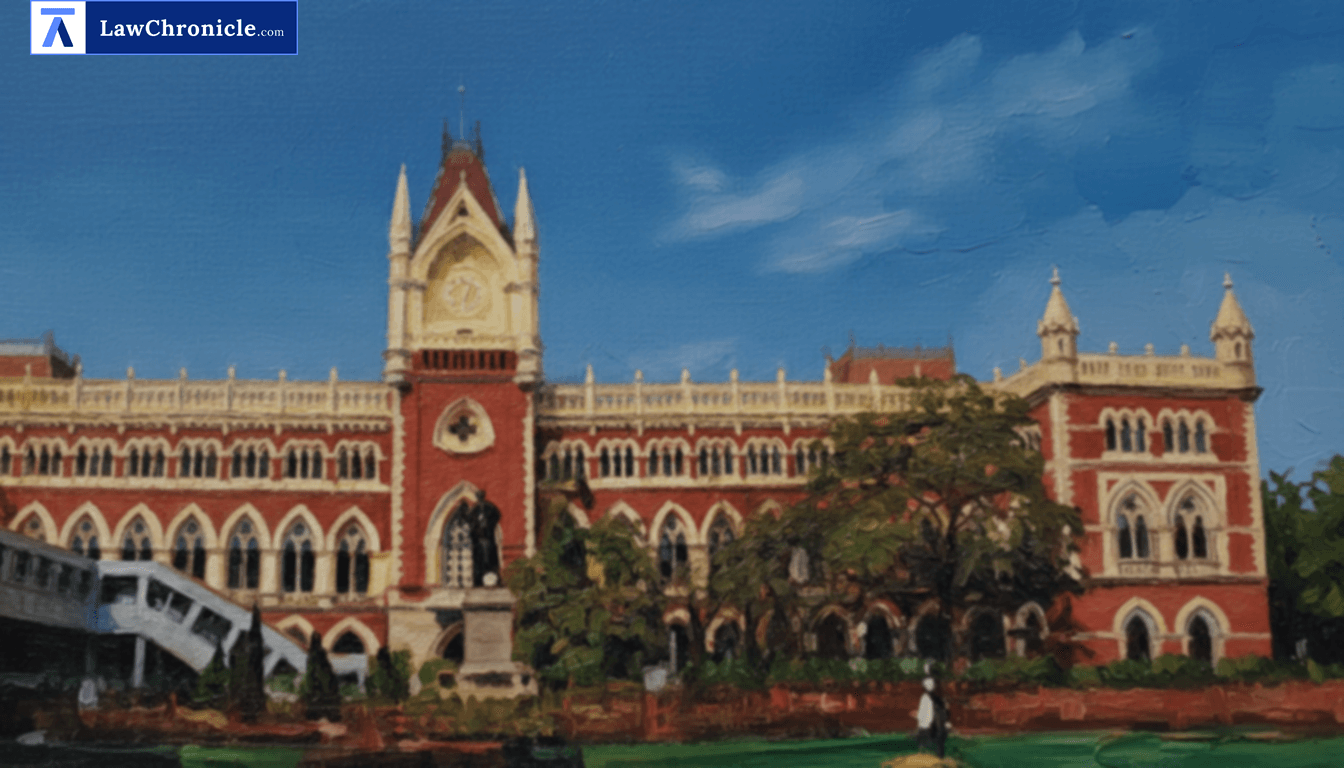
The Calcutta High Court has slammed the door on respondents seeking to intervene at the preliminary stage of Customs appeals, ruling that the statutory framework mandates an ex-parte inquisitorial screening to preserve judicial efficiency. In a decisive clarification of appellate procedure, the Court held that jurisdictional challenges and merits-based objections are statutorily deferred to the final hearing, preventing the conversion of a threshold filter into a protracted mini-trial.
A Division Bench comprising Justice Rajarshi Bharadwaj and Justice Uday Kumar was seized of a batch of statutory appeals filed by the Revenue under Section 130 of the Customs Act, 1962. The appeals, directed against final orders of the Customs, Excise & Service Tax Appellate Tribunal (CESTAT), faced an immediate procedural challenge from the respondents who sought a hearing on maintainability even before the appeals were formally admitted.
Inquisitorial Gatekeeping vs. Adversarial Intervention
The Court addressed the foundational procedural question of whether a respondent possesses locus standi at the pre-admission stage. The respondents had argued that under Rule VI, Part XX, Chapter XXXVIII of the High Court at Calcutta (Original Side) Rules, 1914, and by drawing parallels to Section 100 of the Code of Civil Procedure, the Court should permit them to demonstrate the absence of a substantial question of law at the inception. They specifically raised jurisdictional issues regarding the "rate of duty" and the applicability of exemption notifications, citing Asma Lateef v. Shabbir Ahmad ( "(2024) 4 SCC 696": 2024 CaseBase(SC) 975) and Nusli Neville Wadia v. Ivory Properties ( "(2020) 6 SCC 557": 2019 CaseBase(SC) 3629) to argue that jurisdictional defects must be resolved immediately.
Rejecting these contentions, the Court observed that the Customs Act, 1962 is a meticulously crafted procedural ladder where the admission stage serves as a "swift, preliminary filter." The Bench emphasized that internal court rules cannot circumvent the express statutory sequence enacted by Parliament. The Court noted that allowing such interventions would "clog the judicial pipeline" by turning a summary screening into a full-blown trial.
Deferment of Respondent Rights Under Section 130
The Court clarified that the respondent's right to challenge the appeal is not extinguished but merely postponed. Relying on the precedent in R. Nagaraj (Dead) through LRs v. Rajmani & Ors. ( "2025 SCC OnLine SC 762": 2025 CaseBase(SC) 665), the Bench highlighted that the statutory scheme intentionally segregates the "Admission" phase from the "Final Hearing." The Bench noted that the respondent can fully agitate issues of jurisdiction or maintainability under Section 130(5) after the Court has satisfied itself that a substantial question of law exists.
The Court, in its reasoning, observed: "The Respondents' presence at this bar for the purpose of challenging maintainability is premature, and we must proceed with the screening process as mandated by the Act. Consistency is the bedrock of judicial practice... the sanctity of this two-stage process must be maintained. To allow the Respondents to intervene now... would be to destabilize the appellate architecture envisioned by the legislature."
Key Takeaways:
Statutory Precedence Over Court Rules
Internal High Court rules for administration cannot override the specific procedural sequences mandated by the Customs Act, 1962 for admitting appeals.
Ex-Parte Admission is Mandatory
Section 130 of the Customs Act, 1962 functions as an inquisitorial gatekeeping exercise where the Court alone determines the existence of a substantial question of law without respondent intervention.
No Premature Jurisdictional Trials
Complex jurisdictional questions, including those related to the "rate of duty," cannot be used to force a mini-trial at the pre-admission stage; they must be deferred to the final hearing under Section 130(5).
Strict Procedural Discipline
Unless a formal caveat is filed or delay-related issues exist, respondents have no locus standi to participate in the summary screening process of a statutory tax appeal.
Ratio Decidendi:
In a Customs Appeal filed under Section 130 of the Customs Act, 1962, the admission stage is an ex-parte inquisitorial process designed to filter substantial questions of law. A respondent has no locus standi to be heard on maintainability or jurisdiction at the pre-admission stage; such rights are statutorily deferred to the post-admission final hearing stage under Section 130(5) of the Act.
Background:
The Revenue preferred multiple statutory appeals against orders passed by the CESTAT, Kolkata. At the admission hearing, respondents appeared voluntarily to argue that the appeals were not maintainable before the High Court, contending that the disputes involved the "rate of duty," which under Section 130E, falls within the exclusive jurisdiction of the Supreme Court. The respondents attempted to bridge the procedural gap by invoking the Code of Civil Procedure and the Finance Act, 1994, arguing for a holistic application of natural justice. The Revenue countered that Section 130 is a self-contained code and cited R. Nagaraj (Dead) through LRs v. Rajmani & Ors. ( "2025 SCC OnLine SC 762": 2025 CaseBase(SC) 665) to prove that the admission stage must be ex-parte. The High Court, maintaining consistency with its earlier ruling in OCOT 06 of 2025, rejected the respondents' plea to be heard at this stage and directed them to withdraw, scheduling the ex-parte admission hearing for a later date.
Case Details:
Case No.: CUSTA 88 OF 2025 (and connected matters)
Case Title: Commissioner of Customs Port vs. M/S Greenpanel Industries Limited (formerly M/S Greenply Industries Ltd)
Appearances:
For the Petitioner(s): Mr. Vipul Kundalia, Ld. Sr. Adv.; Mr. Anurag Roy, Ld. Adv.; Mr. Tapan Bhanja, Ld. Adv.
For the Respondent(s): Mr. Rahul Tangri, Ld. Adv.; Ms. Taniya Roy, Ld. Adv.; Mr. Arnab Chakraborty, Ld. Adv.; Mr. Aniket Chaudhury, Ld. Adv.; Ms. Shreya Mundhra, Ld. Adv.
Source: 2026 CaseBase(CAL) 26
Similar Articles
 Breaking News


