


Scientific Impossibility Trumps Ocular Testimony: Allahabad HC Acquits 14 in Triple Murder Case
 Copy Link
 Share
 Save
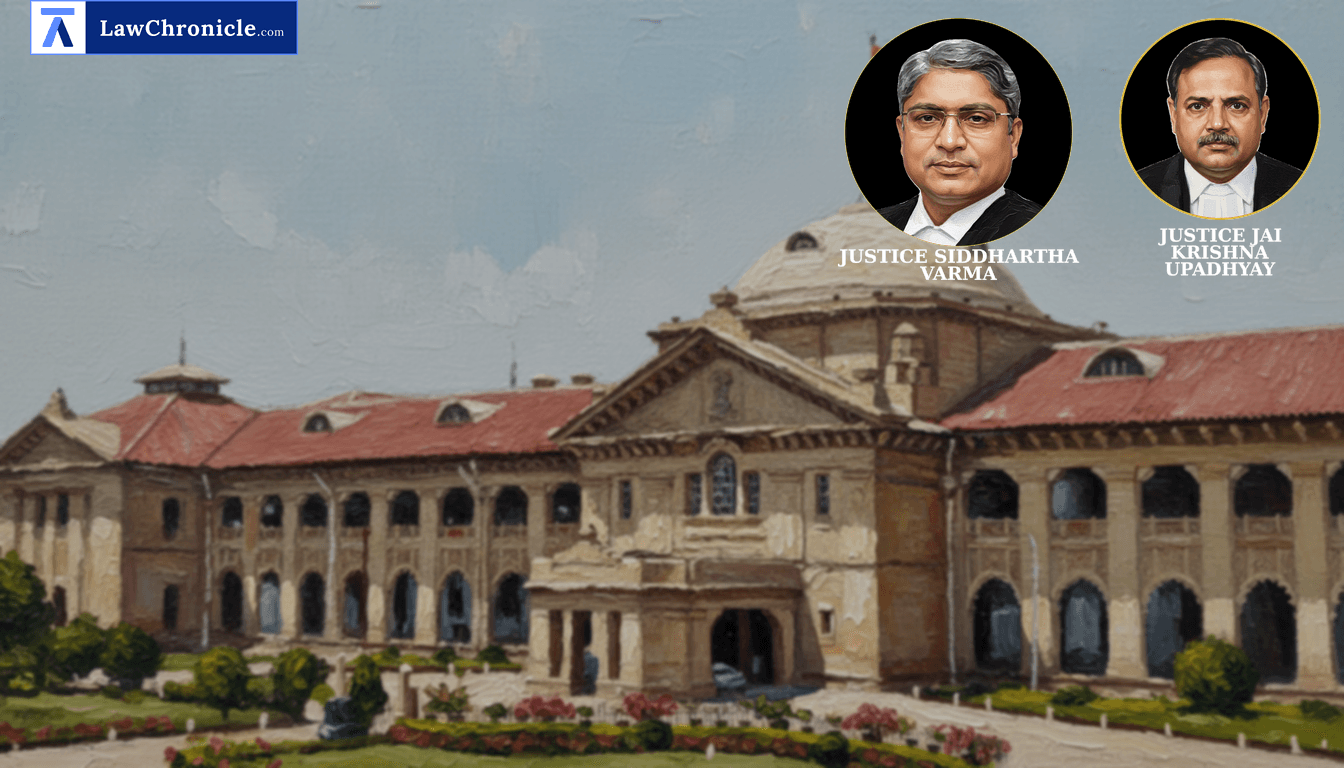
In a severe indictment of police investigation and tutored witness testimony, the Allahabad High Court has set aside the conviction of 14 men in a high-profile triple murder case, ruling that scientific and mechanical evidence showing no fire damage to an allegedly colliding vehicle renders the entire prosecution narrative a 'staged and fabricated police setup.' The Bench emphasized that when the physical laws of science and technical inspection reports flatly contradict ocular accounts, the core truth of the case is destroyed, necessitating an honorable acquittal.
A bench comprising Justice Siddhartha Varma and Justice Jai Krishna Upadhyay delivered this significant verdict while hearing a cluster of criminal appeals challenging a 2018 trial court order. The case concerned a brutal 2012 ambush where three individuals were shot and two were subsequently charred to death inside their vehicle. The Allahabad High Court , however, found the evidence trail so riddled with 'structural expansions' and 'station-house tutoring' that it extended the benefit of doubt to all accused-appellants.
Key Takeaways
Primacy of Scientific Evidence
The court established that objective technical and mechanical inspection reports must prevail over ocular testimony when the latter asserts physical impossibilities.
Fatal Impact of Ante-timed FIRs
Admissions by witnesses that a complaint was finalized only after site visits and deliberations at the police station destroy the 'sacred authenticity' of the FIR.
Doctrine of the Sterling Witness
Witnesses who provide irreconcilable versions of seating arrangements and escape routes fail the test of 'sterling quality' required for a murder conviction.
Invalidity of Tutored Identifications
Identifying unknown accused for the first time in court without a prior Test Identification Parade (TIP), especially after police prompting, carries zero legal value.
Court Rationale on Medical and Mechanical Discrepancies
The Allahabad High Court observed a 'comprehensive, multi-layered collapse' of the prosecution's narrative. While eyewitnesses Rai Sandeep @ Deepu v. State (NCT of Delhi) ( "(2012) 8 SCC 21": 2012 CaseBase(SC) 82) and others claimed the victim was shot from behind from a distance of 30 feet, the post-mortem report proven by Solanki Chimanbhai Ukabhai v. State of Gujarat ( "(1983) 2 SCC 174": 1983 CaseBase(SC) 309) revealed close-range frontal entry wounds with blackening and tattooing. Furthermore, a Mahindra Bolero allegedly involved in a head-on collision and stationed next to a 40-minute 'thermal inferno' was found by Thaman Kumar v. State of Union Territory of Chandigarh ( "(2003) 6 SCC 380": 2003 CaseBase(SC) 308) to have fully inflated tires and zero burn marks.
The Bench observed that “Under the simple laws of physics and common sense, this technical finding makes the prosecution story physically impossible. If a vehicle (Bolero) is stationed immediately next to or locked in a head-on collision with another car (Indica) that burns fiercely for 30 to 40 minutes... the adjacent Bolero would naturally suffer heavy fire damage, melted plastic, smoke soot, and burnt tires. The complete absence of any burn marks, unburnt bumpers and fully inflated tires scientifically proves that the Bolero was never present during the fire and was later planted there.”
Ratio
Where technical, mechanical, and medical evidence proves an oral version of an incident to be physically and scientifically impossible, the ocular testimony must be discarded as fabricated. Furthermore, an FIR finalized after site visits and prolonged police station deliberations is deemed ante-timed, and a recovery memo signed ex-post-facto violates Section 27 of the Indian Evidence Act, 1872.
Background
The dispute originated from a 2012 incident where an Indica car carrying four persons was allegedly rammed by a Bolero. Prosecution witnesses, including Rai Sandeep @ Deepu v. State (NCT of Delhi) ( "(2012) 8 SCC 21": 2012 CaseBase(SC) 82), Amar Singh v. State (NCT of Delhi) ( "(2020) 19 SCC 165": 2020 CaseBase(SC) 780), and Kannaiya v. State of Madhya Pradesh ( "2025 SCC OnLine 2270": 2025 CaseBase(SC) 1067), claimed the accused fired indiscriminately, killing Shashi Kumar near a brick kiln and setting the car on fire with two others inside. The police initially named 8 persons under the Indian Penal Code, 1860 and the Criminal Law (Amendment) Act, 2018, but later expanded the list to 14 accused and three vehicles, including a Mahindra Verito.
The Allahabad High Court noted that the witnesses were coached by the police to include a third vehicle because "14 men could not fit into two cars," a fact admitted during cross-examination. Citing Kanan & Ors. v. State of Kerala ( "(1979) 3 SCC 319": 1979 CaseBase(SC) 278) and Subramanya v. State of Karnataka ( "2022 SCC OnLine SC 1400": 2022 CaseBase(SC) 1045), the Allahabad High Court held that the absence of a Test Identification Parade for unknown accused, combined with the 48-hour delay in transmitting the FIR to the Magistrate, violated the principles laid down in Thulia Kali v. State of Tamil Nadu ( "(1972) 3 SCC 393": 1972 CaseBase(SC) 221) and Meharaj Singh and Others v. State of Uttar Pradesh and Others ( "(1994) 5 SCC 188": 1994 CaseBase(SC) 1045). Consequently, the court acquitted the appellants of all charges under the Indian Penal Code, 1860, Arms Act, 1959 , and Code Of Criminal Procedure, 1973.
Case Details:
Case No.: CRIMINAL APPEAL No. - 2090 of 2018
Case Title: Munna Alias Nitij vs State of U.P.
Appearances:
For the Petitioner(s): A.C.Srivastava, Ajay Kumar, Manish Chand Umrao, Apul Misra, Satya Dheer Singh Jadaun, Akhilesh Singh, Rajarshi Gupta, Ziya Uddin, Noor Mohammad (Advocates)
For the Respondent(s): Harish Chandra Pratap (Additional Government Advocate)
Source: 2026 CaseBase(ALL) 1220
Similar Articles
 Breaking News


