Shyamala Pappu: The Woman Senior Advocate who was awarded Padma Shri
 Copy Link
 Share
Share Save
Save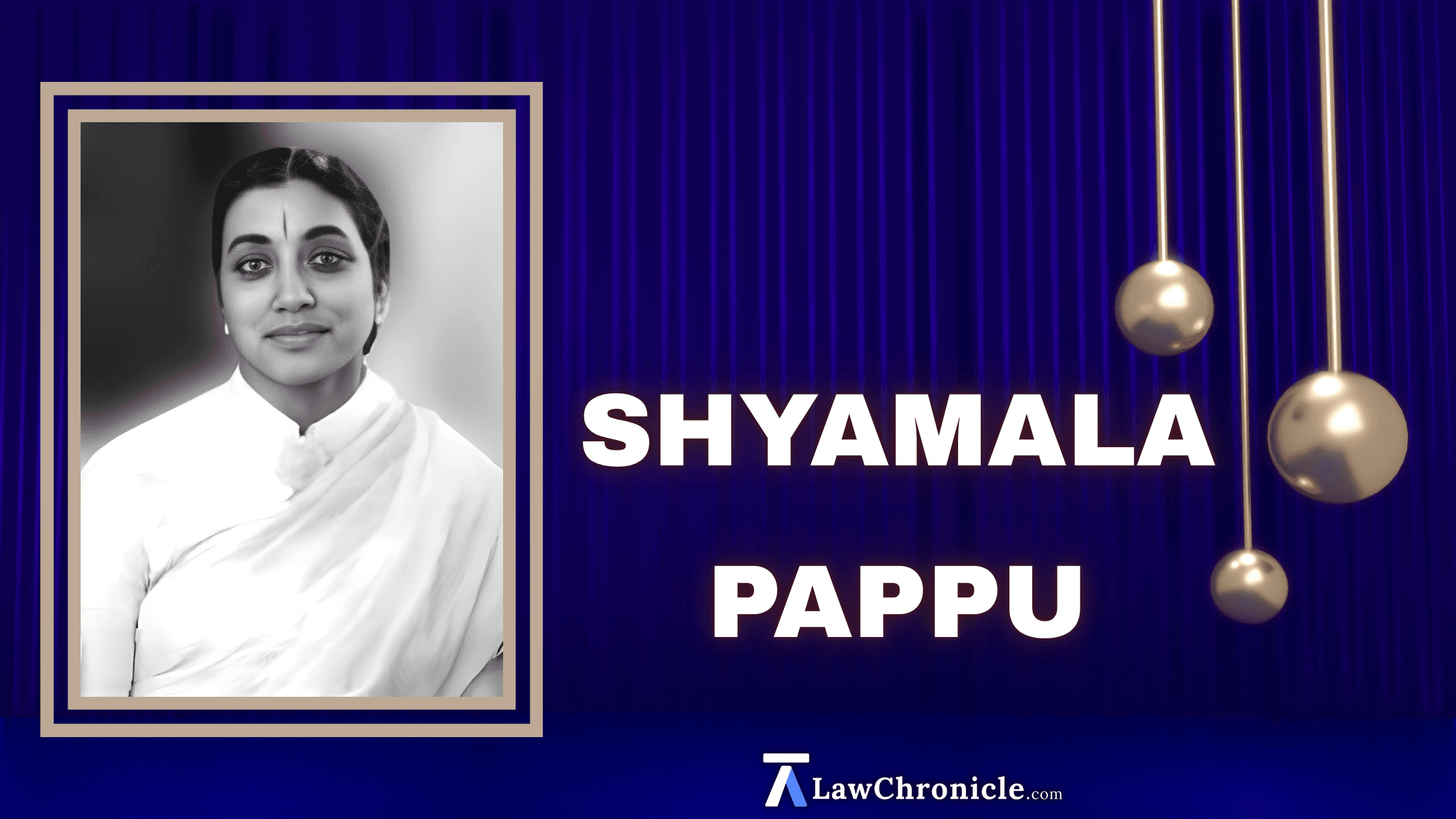
Shyamala Pappu was a Senior Advocate who practised before the Supreme Court of India. She was among the earliest women to be designated a Senior Advocate in independent India in 1971, at the age of 38, by the Delhi High Court. She subsequently became a Central Government Counsel in 1975. Over a career spanning six decades, she specialised in constitutional law, labour rights, women's rights, and public interest litigation. She was a member of the Law Commission of India, the Bar Council of India, and the Supreme Court Bar Association of India. She was an alumna of Miranda House, University of Delhi, and enrolled at the Bar Council of Karnataka in 1955. The Government of India awarded her the Padma Shri in 2009, for her contributions to society. She was recently featured in Raju Ramachandran's “14 Lawyers - Portraits from the Bar”.
This article seeks to trace the journey of Shyamala Pappu as a female Senior Advocate in young independent India.
Early Life and Education
Shyamala Pappu was born on 21 May 1933 in India. She completed her undergraduate studies at Miranda House, a women's college affiliated with the University of Delhi. She was an active participant in campus life, including the college's Students' Union. She maintained a lifelong association with Miranda House, serving on its Governing Council in 1973-74.
Following her graduation from the University of Delhi, Shyamala Pappu pursued legal education and enrolled as an advocate with the Bar Council of Karnataka on 8th October 1955, marking her formal entry into the legal profession.
Legal Career of Shyamala Pappu
Early Practice in Bengaluru
Shyamala Pappu commenced her early professional career in Bengaluru, initially working as a junior advocate under senior members of the Mysore High Court Bar, including T. Krishna Rao and S.K. Venkataranga Iyengar. Her early practice focused on general civil matters and labour-related disputes. She was one of very few women in the legal profession at that time, a period characterised by systemic underrepresentation of women at the Bar and gender biases in courtroom environments. In 1966, she moved to Delhi to practice before the Supreme Court and Delhi High Court.
Designation as Senior Advocate
Shyamala Pappu was designated a Senior Advocate by the Delhi High Court in 1971, at the age of 38. This made her one of the earliest women in India to achieve this designation. In 1975, she became a Central Government Counsel, representing the government before the Supreme Court and High Courts.
Areas of Specialisation
Shyamala Pappu specialized in constitutional law, advancing arguments on fundamental rights under Constitution of India, pertaining to equality before law, non-discrimination, equality of opportunity in public employment, and right to life and personal liberty. Her advocacy frequently engaged Directive Principles of State Policy, particularly socialist principles, seeking to integrate them into enforceable fundamental rights. She also worked on issues of federalism, including interstate water disputes.
She began her career representing working-class clients and trade unions, often aligning with left-wing causes, and contributed to the early development of labour jurisprudence in the Supreme Court. Her practice evolved to focus significantly on women's rights, providing legal services to organizations such as the YWCA and contributing to legislative reform.
Notable Cases of Shyamala Pappu
Indra Sawhney v. Union of India (1992 CaseBase(SC) 839) - Also known as the Mandal Commission case
Shyamala Pappu argued on behalf of petitioners challenging the implementation of the Mandal Commission's recommendations for 27% reservations for Other Backward Classes (OBCs) in public employment. It was contended that such reservations perpetuated caste divisions and violated equality principles under Article 14, while also critiquing the absence of a creamy layer exclusion. The Supreme Court's judgment upheld 27% OBC reservations but introduced the creamy layer concept and capped total reservations at 50%, fundamentally shaping affirmative action jurisprudence in India.
Krishna Water Disputes (1969–1976)
Shyamala Pappu represented Andhra Pradesh in arguments over equitable allocation of Krishna River waters among Maharashtra, Karnataka, and Andhra Pradesh, under the Interstate Water Disputes Act, 1956. Her advocacy ensured substantial water allocations for downstream states and reinforced cooperative federalism in resource management.
Legislative contribution in Hindu Marriage Act
Pappu contributed to legislative reform by providing input on amendments to the Hindu Marriage Act, 1955, including provisions for divorce by mutual consent under Section 13B enacted in 1976. This contributed to the advancement of gender equality in present day family law.
Public Positions and Legal Philosophy
Shyamala Pappu was a member of the Law Commission of India, the Bar Council of India, and the Independent Commission on Development and Health in India (ICDHI). She was a member of the Governing Council of Miranda House (1973-74). She participated in several conferences and delivered keynote addresses on legal and judicial reform topics. Her legal philosophy emphasized transformative justice, integrating the socialist goals of the Directive Principles of State Policy into enforceable constitutional rights, and expanding locus standi to allow marginalized groups access to courts.
Awards and Recognition
Padma Shri: Shyamala Pappu has been conferred with the Padma Shri award by the Government of India, presented by President Pratibha Devisingh Patil on 14th April 2009, at Rashtrapati Bhavan. The award recognized her contributions to law and public affairs, particularly her advocacy for women's rights and social justice.
Personal Life
Shyamala Pappu's son, M.R. Krishnamoorthi Pappu, established the Shyamala Pappu Law Foundation (also known as Shyamlha Pappu Law Foundation) in her memory. Outside the courtroom, she was known as an avid singer with exceptional vocal talent, and as an engaging raconteur and mimic who enlivened social gatherings.
She died on 7th September 2016 in Delhi at the age of 83. On her passing, Supreme Court Bar Association President Dushyant Dave described her as a 'doyen' of the Bar who had played a significant role in shaping Supreme Court jurisprudence during the 1970s and 1980s.
Shyamala Pappu's Legacy
The Shyamala Pappu Law Foundation (also known as Shyamlha Pappu Law Foundation), founded by her son Krishnamoorthi Pappu, established the annual Shyamala Pappu Memorial Lecture series. The inaugural lecture was delivered by Supreme Court Justice S. Ravindra Bhat in 2022 at the Indian Law Institute, on 'Trailblazing Women in Law'. The second lecture was delivered by Justice Abhay S. Oka in 2023 on access to justice.
Shyamala Pappu Law Foundation Website: https://www.shyamlhapappulawfoundation.com/
 Breaking News