


Speedy Trial Is A Human Right; Prosecution Cannot Become Persecution: SC
 Copy Link
 Share
 Save
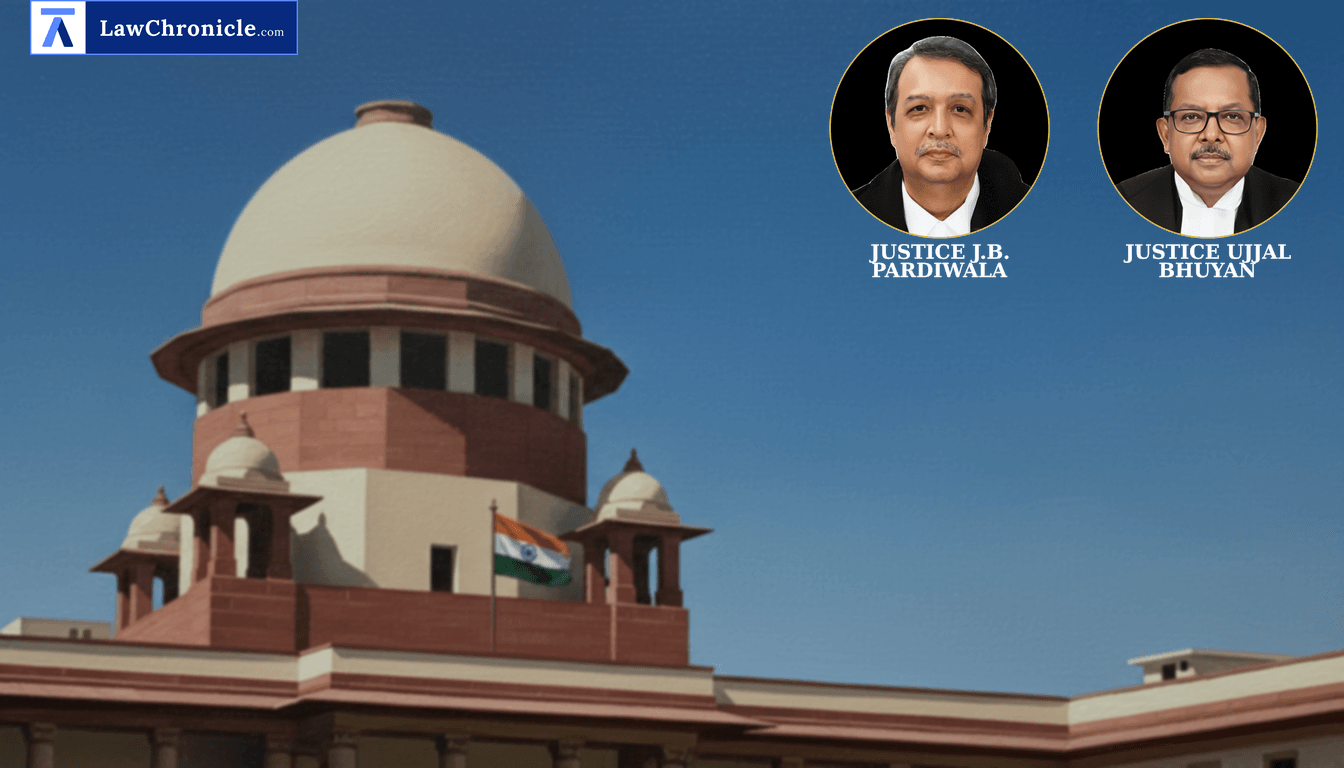
The Supreme Court quashed a 35-year-old criminal case, holding that the right to a speedy trial is an integral part of the fundamental rights guaranteed under the Constitution of India, 1950. The Court emphasized that keeping an individual in a state of 'suspended animation' for decades over minor offences violates human dignity and the constitutional mandate of a fair procedure.
A bench comprising Justice J.B. Pardiwala and Justice Ujjal Bhuyan heard an appeal arising from a 1989 incident involving police constables. The appellant had challenged an Allahabad High Court order which refused to quash proceedings that had remained pending for over three decades despite the acquittal of co-accused due to lack of evidence.
Speedy Trial as a Fundamental and Human Right
The Court observed that the right to a speedy trial is not an abstract theory but a hard reality rooted in the need for prompt justice. Relying on various precedents such as Hussainra Khatoon v. State of Bihar and Maneka Gandhi v. Union of India ( "AIR 1978 SC 597": 1978 CaseBase(SC) 307), the bench noted that any procedure which does not ensure a reasonably quick trial cannot be regarded as 'reasonable, fair or just' under Article 21.
The Court, in its reasoning, observed: "The right to speedy trial is also a human right and no civilized society can deny the same to an accused. Furthermore, it should always be the concern of the society to see that a real culprit is given the condign punishment at the earliest and also to see that an accused is given an early opportunity to clear the cloud of suspicion shrouded around him and to remove the tag of 'accused'."
The Distinction Between Prosecution and Persecution
Analyzing the delay, the Court noted that the appellant, who was 22 at the time of the alleged incident, is now 59. It highlighted that the Code Of Criminal Procedure and BNSS 2023 empower courts to effectuate speedy trials, as reaffirmed in P. Ramachandra Rao vs. State of Karnataka ( "AIR 2002 SC 1856": 2002 CaseBase(SC) 116). The bench warned that while the nature of the offence is a factor, inordinately long delays, as seen in Abdul Rehman Antulay & Ors. v. R.S. Nayak & Anr. ( "[1992] 1 SCC 225": 1991 CaseBase(SC) 481) or Union of India vs. K. A. Najeeb ( "Criminal Appeal No.98 of 2021 decided on 1st February 2021": 2021 CaseBase(SC) 830), transform prosecution into persecution.
Directives to Allahabad High Court
Expressing concern over systemic delays in Uttar Pradesh, the Court issued extensive directions to the Registrar General of the Allahabad High Court to furnish detailed data regarding pending criminal cases, under trial prisoners, and judicial vacancies.
The Court has the following directions:
"i. How many criminal cases are pending as on date in the courts of Judicial Magistrate First Class and Chief Judicial Magistrates? How old are these cases pending before the Judicial Magistrate First Class and the Chief Judicial Magistrates respectively in the State? In how many cases the accused persons are in jail as under trial prisoners and since how long? What is the status of these criminal cases and what are the impediments coming in the way of different courts in proceeding further with these cases?
ii. How many sessions cases are pending as on date in the sessions courts? How old are these cases pending before the sessions courts in the State? In how many cases the accused persons are in jail as under trial prisoners and since how long? What is the status of these criminal cases and what are the impediments coming in the way of different courts in proceeding further with these cases?
iii. How many judicial officers are functioning as on date in the rank of Judicial Magistrate First Class, Chief Judicial Magistrate and Sessions judge respectively?
iv. How many sanctioned posts are there in so far as civil judges and JMFCs are concerned? How many sanctioned posts are there in the cadre of Chief Judicial Magistrate? How many sanctioned posts are there for the post Sessions judge?
v. How many posts are lying vacant in so far as the judicial officers of different cadres referred to above are concerned.
vi. Are there any proposals forwarded by the High Court pending with the State Government for filling up of various posts at the level of Judicial Magistrate First Class, Chief Judicial Magistrate and Sessions judges?"
Background:
The dispute began on February 19, 1989, when an FIR was lodged under Sections 147, 323, and 504 of the Indian Penal Code, 1860 and Section 120 of the Railways Act, 1989 following a scuffle between police constables in a mess over food. While a chargesheet was filed in 1991, the trial saw zero progress regarding the appellant for 35 years. Two co-accused died pending trial, and two others were acquitted in 2023 after the prosecution failed to produce a single witness in 33 years.
The Allahabad High Court had dismissed the appellant's petition under Section 482 of the Code Of Criminal Procedure, suggesting he move a discharge application. However, the Supreme Court set aside this order, holding that for a case involving 'simple hurt', a 35-year wait is 'just unfair' and inconsistent with equity. The bench cited Imityaz Ahmad vs. State of Uttar Pradesh & Ors. ( "(2012) 2 SCC 688": 2012 CaseBase(SC) 149) and Union of India vs. K. A. Najeeb ( "Criminal Appeal No.98 of 2021 decided on 1st February 2021": 2021 CaseBase(SC) 830) to illustrate that even in grave offences, prolonged delay necessitates judicial intervention to protect liberty.
Case Details:
Case No.: Criminal Appeal No. of 2026 (Arising out of SLP (Crl.) No. 6564 of 2026)
NeutralCitation: 2026 INSC 473
Case Title: Kailash Chandra Kapri v. State of Uttar Pradesh & Ors.
Source: 2026 CaseBase(SC) 549
Similar Articles

 Breaking News


