


State Cannot Arbitrarily Withhold Contractual Dues: Andhra Pradesh HC
 Copy Link
 Share
 Save
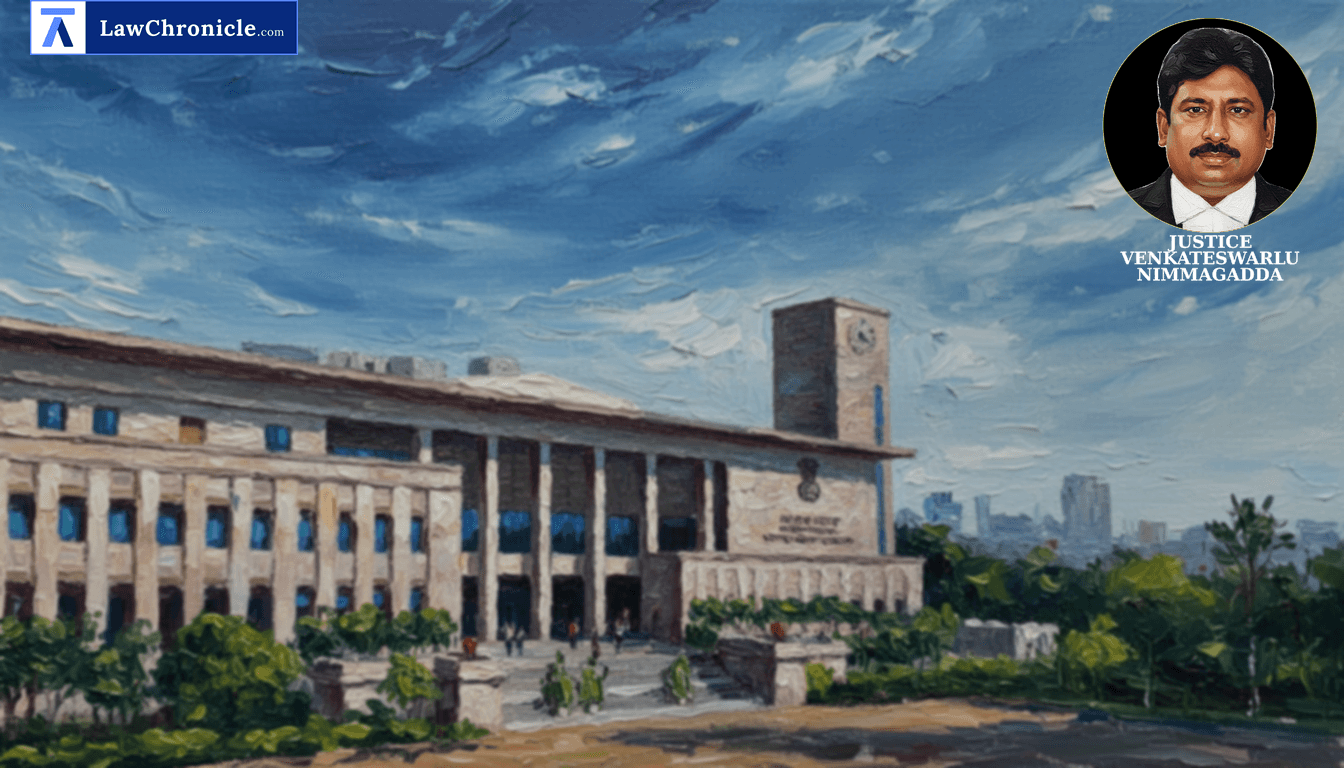
The Andhra Pradesh High Court has reinforced the principle of executive accountability in contractual obligations, ruling that the non-payment of admitted dues for government works constitutes an arbitrary exercise of power. In a stern directive to the state machinery, the court mandated the immediate release of funds for infrastructure works under the 'Navaratnalu Pedalandaraki Illu' scheme, emphasizing that administrative delays cannot override the fundamental rights of contractors.
Justice Venkateswarlu Nimmagadda, sitting as a single judge bench, adjudicated upon the writ petition filed under Article 226 of the Constitution of India. The petitioner, a contractor, sought a Writ of Mandamus against the state authorities for the failure to release payments amounting to over Rs. 21 Lakhs for civil works involving land leveling and filling in YSR Jagananna layout colonies.
Key Takeaways
Curbing Executive Arbitrariness
Government departments cannot indefinitely withhold payments for works already executed and admitted, as such inaction is deemed high-handed and violative of the right to equality.
Fixed Timelines for Payments
High Courts are increasingly setting strict three-to-four-month deadlines for the State to clear outstanding bills to prevent financial distress for small-scale contractors.
Entitlement to Interest
Even if not explicitly admitted in the final bill, contractors are entitled to interest on delayed payments based on agreement terms or established judicial precedents.
Judicial Recourse for Differentials
Petitioners retain the liberty to approach appropriate forums to litigate claims regarding any amounts not admitted by the State.
Court Observations and Directions
The Court noted that the respondents admitted to a net amount of Rs.16,87,390/- being payable as per the M.Book, yet the bill had not been uploaded for payment. Referring to the precedent set in W.P.No.10038 of 2021 and batch, the bench reiterated that the State's failure to clear dues at the earliest is an arbitrary act.
The Court has the following directions:
"i) The respondents are directed to release the net amount of Rs.16,87,390/- to the petitioner within a period of three (03) months.
ii) The respondents are hereby directed to pay admitted amount within a period of four months from the date of receipt of copy of this order.
iii) As far as interest is concerned, if both parties have agreed regarding the quantum of amount towards interest, the same should be paid along with admitted amount, if not, petitioner is at liberty to submit a representation or a Memo of Statement requesting for payment of interest. If petitioner is entitled for the same, after such submission of representation or Memo, the concerned respondent authorities shall consider and pass appropriate orders after providing opportunity of hearing to both parties in case of rejection or reduction of interest amount claimed by the petitioner, within a period of four (04) weeks thereafter."
The Court, in its reasoning, observed: "...non-payment of money is clearly arbitrary and high-handed requiring the interference of this Court. ... This Court, in various orders... had taken the view that such non-payment of dues is arbitrary and that such dues need to be cleared by the respondents at the earliest."
Ratio
The State is legally bound to release admitted contractual dues within a reasonable timeframe. Any delay in the payment of admitted amounts without justifiable cause is arbitrary and violative of Article 14 of the Constitution of India. Furthermore, contractors are entitled to interest on such delayed payments as per the ratio laid down in W.A.No.724 of 2021, ensuring that the State does not benefit from its own administrative lapses.
Background
The petitioner was awarded contracts for several works titled "NAVARATNALU PEDALANDARAKI ILLU" involving the formation of leveling bits at Vaddigudem layout in West Godavari District. Despite the successful execution of the works and the preparation of final bills, the state authorities failed to release the payments. The petitioner contended that this inaction violated Articles 14 and 21 of the Constitution of India.
During the proceedings, the Standing Counsel for the Andhra Pradesh State Housing Corporation Limited admitted that the net amount was payable but cited the non-uploading of bills as the reason for delay. The Court, while disposing of the petition, relied on earlier judgments concerning similar defaults by state agencies. It granted the petitioner liberty to agitate claims for any differential amounts in an appropriate forum while specifically addressing the issue of interest under Section 151 of the CPC.
Case Details:
Case No.: WRIT PETITION NO: 23387/2026
Neutral Citation: 2026:APHC:47973
Case Title: Gopa Satya Madhava Subbarao V. The State Of Andhra Pradesh And Others
Appearances:
For the Petitioner(s): Annamneedi Balakrishna
For the Respondent(s): GP For Panchayat Raj Rural Dev, Mallikharjuna Moorthy K (SC FOR A.P Housing Corporation Limited), GP For Finance Planning, GP For Housing
Source: 2026 CaseBase(AP) 19902
Similar Articles
 Breaking News


