


State Cannot Use Internal File Defect To Deny Regularisation: SC
 Copy Link
 Share
 Save
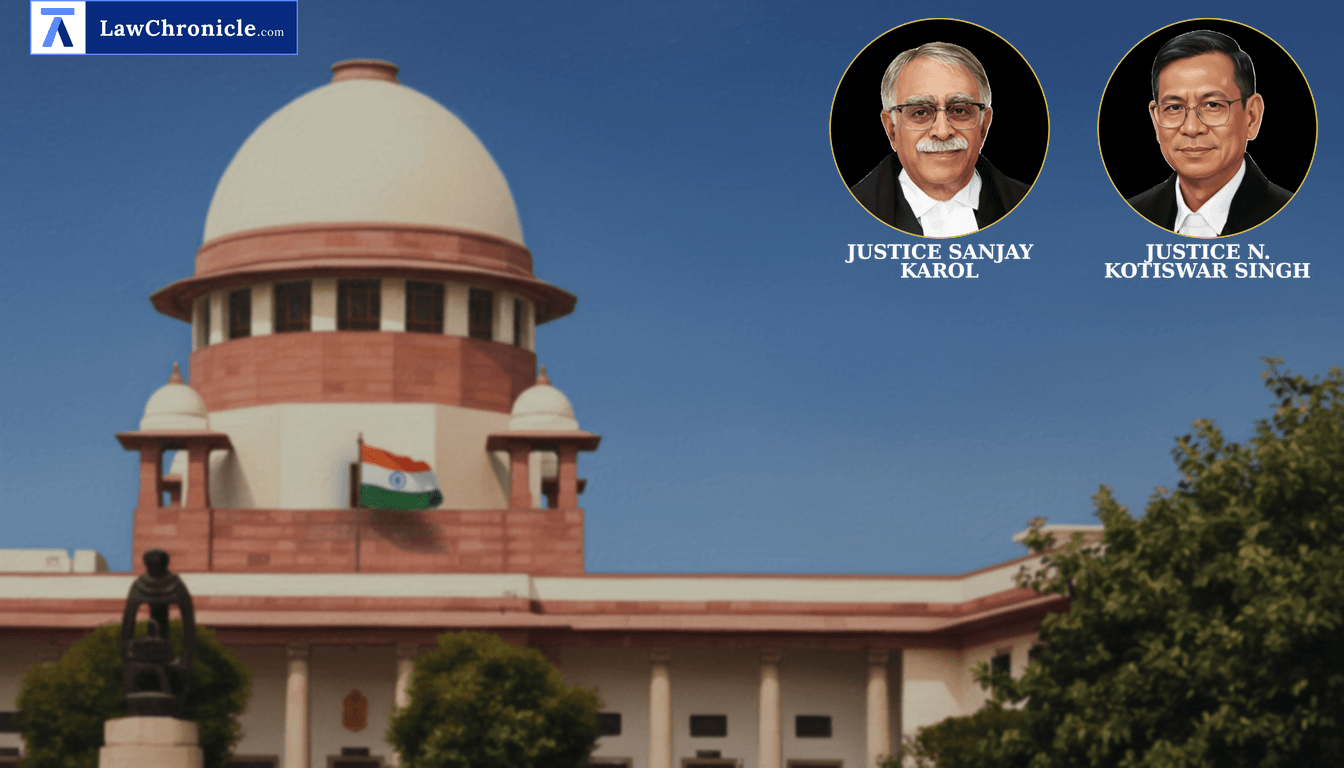
Confronting long-standing executive exploitation of contractual workers, the Supreme Court ruled that a welfare State cannot cast aside temporary employees after availing their uninterrupted service for decades. The Court declared that internal procedural omissions and file infirmities created by the State cannot be invoked to defeat the legitimate claim for regularisation of workers who were conferred temporary status after due administrative scrutiny.
A Bench comprising Justice Sanjay Karol and Justice Nongmeikapam Kotiswar Singh set aside a judgment of the Bombay High Court at Goa that had refused relief to workers supplied through a State-created labour society. The bench observed that a State-backed entity headed by senior functionaries cannot operate to perpetuate permanent temporariness for workers discharging regular and perennial duties.
Key Takeaways
State as a Model Employer: Welfare States cannot exploit long-serving workers by relying on internal file procedural lapses of their own creation.
Limits of Refusal under Precedents: Judicial precedents prohibiting backdoor entry cannot be used as a shield to legitimize indefinite contractual engagements in perennial roles.
Mandatory Creation of Supernumerary Posts: If sanctioned vacant posts are unavailable, the State must create personal supernumerary posts to ensure absorption.
Court Observations and Directions
Summarizing the core responsibility of the public administration, the Court noted that when temporary status is granted afterCabinet-level decisions and categorization, it represents a conscious administrative commitment. The Court, in its reasoning, observed: "Temporary status, so conferred after a structured administrative exercise involving Cabinet decisions, categorisation, and assessment of suitability, is not to be treated as an empty administrative label devoid of legal consequence. It is the outward manifestation of the State’s own considered intention to absorb the workers."
The Court issued the following directions:
"(i) The judgment and final order dated 28.07.2023 passed by the High Court of Bombay at Goa in Writ Petition No. 95 of 2021, along with the connected Writ Petition No. 147 of 2021, is set aside.
(ii) The appellants are held entitled to regularisation of their services in the establishment of the Public Works Department, Government of Goa, in the posts/categories to which they were assigned pursuant to the categorisation exercise undertaken by the State in 2013 and given temporary status.
(iii) The respondent-State shall, within a period of four months from today, frame an appropriate scheme to give effect to the regularisation directed herein. The scheme so framed shall be strictly limited to, and shall enure only for the benefit of, the members of the society who were members of the society at the time of institution of the writ petition, WP(C) No. 95 of 2001 on 09.02.2021, and shall not be treated as a precedent for, or extended to, any other worker who were not members of the society on the date of the filing of the writ petition on 09.02.2021.
(iv) In the event sufficient sanctioned vacant posts are not presently available to accommodate all the appellants/workers as mentioned above, the respondent-State shall create supernumerary posts, on a one-to-one basis, to the extent necessary to absorb the appellants/workers. Such supernumerary posts shall be personal to the appellants concerned, shall stand automatically abolished upon the retirement, resignation, death or cessation of service of the incumbent appellant/workers, and shall not enure for the benefit of any successor or be treated as a sanctioned addition to the regular cadre strength for any other purpose.
(v) The appellants/workers shall be deemed to have been regularised in service with effect from 09.02.2021, being the date of institution of Writ Petition No. 95 of 2021, the first writ proceeding instituted by the appellants/workers in their own right, and shall be entitled to all consequential and attendant benefits of regularisation, including seniority and pensionary and retiral benefits, reckoned with effect from the said date.
(vi) Notwithstanding clause (v) above, monetary arrears of pay and allowances consequent upon such regularisation shall not be payable for any period prior to the date of this judgment."
Ratio
Where the State consciously establishes an institutional mechanism, grants temporary status with pay parity following an official evaluation process, and continuously utilizes workers for essential and regular work over long periods, it cannot rely on its own procedural file omissions or a mechanical application of public recruitment rules to deny one-time regularisation.
Background
The dispute originated from the engagement of workers between 1967 and 2003 through private contractors for the Public Works Department (PWD) in Goa. To eliminate contractor exploitation, the State established the PWD Labour Supply Society, headed by the Principal Chief Engineer. Over time, state authorities formulated policies to absorb these workers, freeze direct recruitment, and grant them temporary status under an order dated February 7, 2014.
When the State failed to finalize regularisation and issued fresh recruitment advertisements, affected workers approached the High Court. However, the High Court dismissed their writ petition, holding that the original engagement lacked formal recruitment process compliance under Article 14 and Article 16 of the Constitution of India, relying on State of Karnataka v. Umadevi (3) ( "(2006) 4 SCC 1": 2006 CaseBase(SC) 148). The High Court also noted that the order granting temporary status lacked formal administrative concurrence under Article 166 of the Constitution of India and that members of an entity registered under the Societies Registration Act, 1860 could not claim direct regularisation or post creation in light of Union of India v. Ilmo Devi ( "(2021) 20 SCC 290": 2021 CaseBase(SC) 656) and Official Liquidator v. Dayanand ( "(2008) 10 SCC 1": 2008 CaseBase(SC) 545).
In appeal, the Supreme Court distinguished State of Karnataka v. Umadevi (3) ( "(2006) 4 SCC 1": 2006 CaseBase(SC) 148) by citing State of J&K v. Distt. Bar Assn., Bandipora, Sheo Narain Nagar v. State of U.P. ( "(2018) 13 SCC 432": 2017 CaseBase(SC) 1120), Jaggo v. Union of India ( "2024 SCC OnLine SC 3826": 2024 CaseBase(SC) 715), Vinod Kumar v. Union of India, and Shripal v. Nagar Nigam, Ghaziabad ( "2025 SCC OnLine SC 221": 2025 CaseBase(SC) 263), highlighting that paragraph 53 of State of Karnataka v. Umadevi (3) ( "(2006) 4 SCC 1": 2006 CaseBase(SC) 148) permits a one-time regularisation exception for long-serving irregular appointments. Addressing arguments on counsel concessions under Uptron India Ltd. v. Shammi Bhan ( "(1998) 6 SCC 538": 1998 CaseBase(SC) 722) and promissory estoppel principles under M/s. Motilal Padampat Sugar Mills Co. Ltd. v. State of U.P. and T.R. Dhananjaya v. J. Vasudevan ( "(1995) 5 SCC 619": 1995 CaseBase(SC) 324), the Court held that the State was bound by its deliberate executive commitments and ordered the creation of personal supernumerary posts for absorbing the appellants.
Case Details:
Case No.: Civil Appeal No. 13055 of 2025
Neutral Citation: 2026 INSC 792
Case Title: Rupesh R. Gaonkar & Ors. v. State of Goa & Ors.
Source: 2026 CaseBase(SC) 739
Similar Articles
 Breaking News


