


Supreme Court Upholds Conviction in 1983 Bihar Mass Violence Case
 Copy Link
 Share
 Save
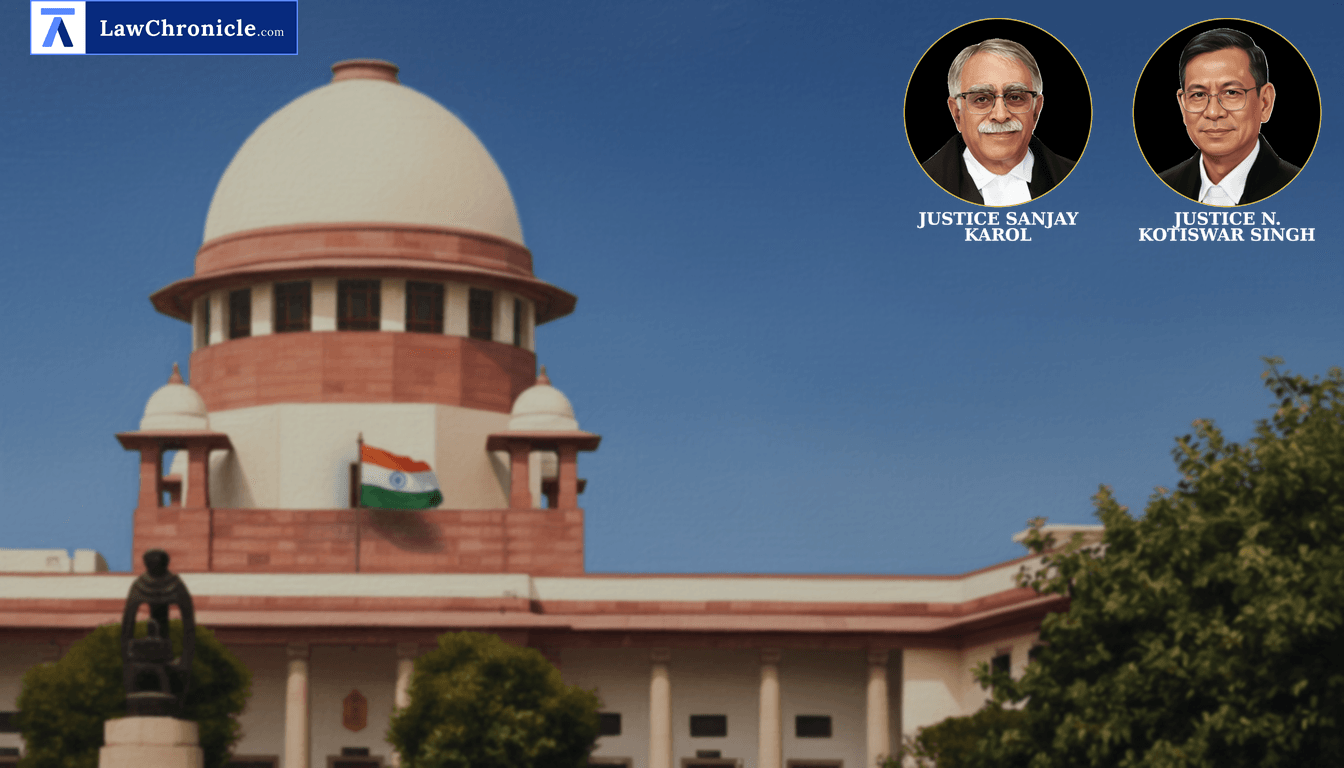
The Supreme Court has affirmed the life sentences for participants in a 1983 brutal mass violence incident in Bihar, emphasizing that vicarious liability under Section 149 of the IPC is squarely attracted when an unlawful assembly acts in furtherance of a common object.
A bench comprising Justice Sanjay Karol and Justice Nongmeikapam Kotiswar Singh dismissed the appeals filed against the judgment of the Patna High Court, which had previously upheld the Trial Court's conviction of the appellants for the murder of five individuals and the burning of a residential house. The Court found the eyewitness testimonies of several injured victims to be consistent and corroborated by medical evidence.
Establishing Common Object and Vicarious Liability
During the proceedings, the appellants argued that their presence was merely incidental and that no common object to commit murder was established. However, the Court rejected these contentions, noting that the assembly was armed with deadly weapons and engaged in a multi-stage attack involving arson and lynching. The Court, in its reasoning, observed: "Once the common object of the unlawful assembly stands established, every member thereof becomes vicariously liable for acts committed in prosecution of such common object. The liability contemplated under Section 149 Indian Penal Code, 1860 squarely stands attracted in the facts of the present case."
Role of the Public Official and Abetment
The Court also scrutinized the role of Jagannath Ravidas, the then Circle Officer, who was charged with abetment. The prosecution established that he forcibly disarmed one of the deceased, Mahanth Indradeo Jyoti, of his licensed firearm, which emboldened the mob to proceed with the massacre. The Court concurred with the lower courts that such actions facilitated the commission of the gruesome offences.
Background:
The dispute originated on March 29, 1983, in Jamalpur Kodai village, Muzaffarpur, Bihar, following a rivalry over a pumping set and a prior criminal case. A mob of approximately 58 people surrounded the house of Chandra Shekhar Choudhary and set it ablaze. Five family members were brutally killed as they tried to flee, while others sustained grievous injuries from weapons like lathi, farsa, and bhala.
The Trial Court had initially convicted the appellants under Sections 302/149, 436/149, 147, 148, 379, 323 and 324 of the Indian Penal Code, 1860. While some accused were granted juvenility benefits under the Juvenile Justice (Care and Protection of Children) Act 2015, the High Court affirmed the principal convictions. The Supreme Court, exercising its jurisdiction under Article 136 of the Constitution of India, found no perversity in the concurrent findings, noting that the brutality of the incident "shocks the judicial conscience."
Case Details:
Case No.: CRIMINAL APPEAL NO(S). 563-564 OF 2020
NeutralCitation: 2026 INSC 560
Case Title: MAHENDRA RAI @ HARENDRA NARAIN SINGH AND ORS. ETC. v. THE STATE OF BIHAR
Source: 2026 CaseBase(SC) 488
Similar Articles

 Breaking News


