


Fraudulent Appointment Cannot Confer Equity Or Estoppel: Allahabad HC
 Copy Link
 Share
 Save
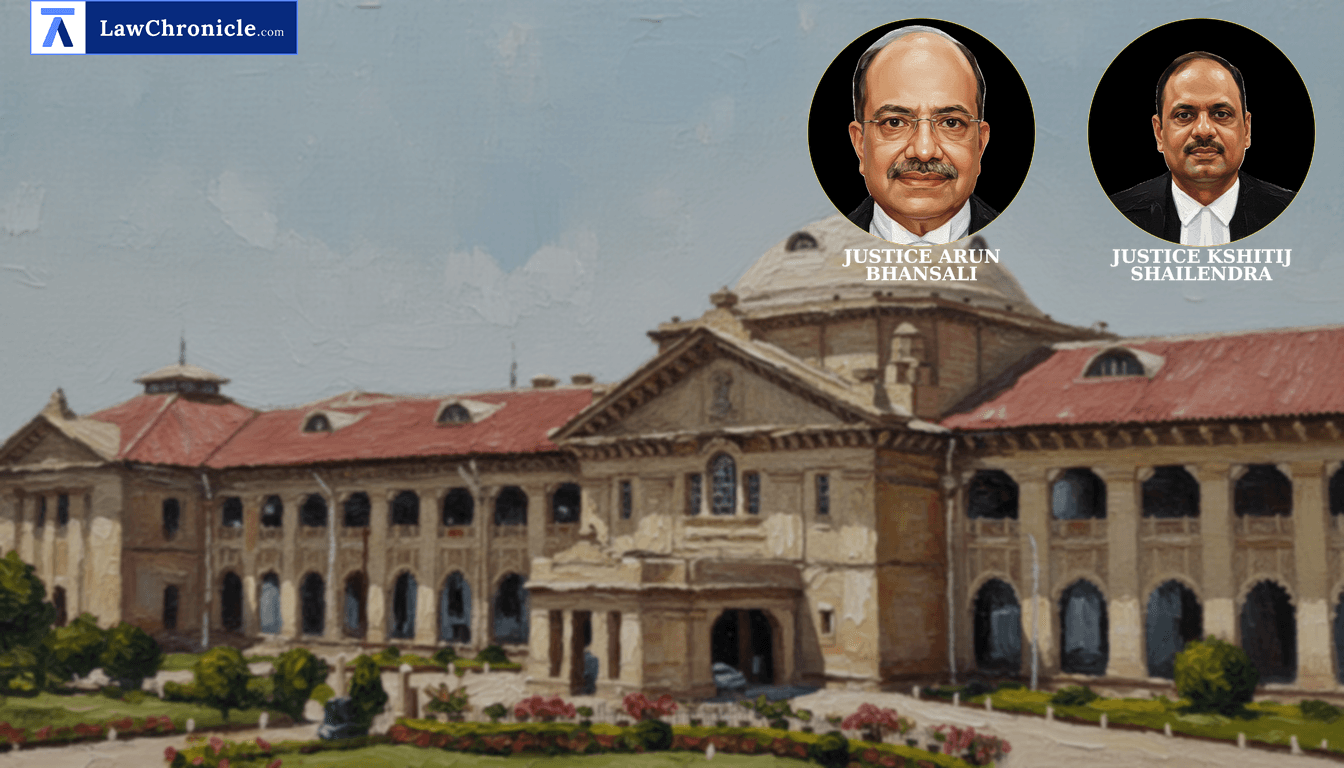
In a decisive blow against public employment fraud, the Allahabad High Court ruled that appointments secured through fraudulent means or under the shelter of interim orders are void from their inception and confer no legal equity upon the beneficiary. Denouncing attempts to validate illicit appointments through judicial delay or technicalities, the Court affirmed that public exchequer monies drawn without lawful entitlement must be recovered to uphold constitutional integrity.
A Division Bench comprising Chief Justice Arun Bhansali and Justice Kshitij Shailendra dismissed a special appeal challenging the termination of an Assistant Teacher whose initial appointment was grounded on a fictitious short-term leave vacancy. The Bench sternly remarked that courts cannot permit the sanctity of public employment to be eroded through deceit, misrepresentation, or abuse of judicial proceedings.
Key Takeaways
No Equity in Fraud: Litigants securing public employment through fraudulent means or interim court orders cannot claim equity or estoppel regardless of their length of service.
Restitution of Public Funds: Unlawful continuance in service does not create indefeasible rights, mandating complete recovery of salaries disbursed from the public exchequer.
Avoidance of Unnecessary Remand: Higher courts must resolve fraudulent appointment disputes directly rather than remanding matters to statutory authorities to prevent endless litigation.
Evaluating the legality of the appointment and the subsequent termination, the Court observed that an interim order always merges into the final decision, and any undeserved benefit gained during the pendency of litigation must be restored.
The Court, in its reasoning, observed: "The constitutional courts cannot permit the sanctity of public employment to be eroded by fraudulent or unlawful appointments secured through deceit, misrepresentation or abuse of judicial process. Public office is a public trust and every appointment made in contravention of law constitutes a direct assault on the constitutional mandate of equality, fairness and transparency embodied in Articles 14 and 16 of the Constitution. An unscrupulous litigant who secures or continues in public employment by obtaining interim protection from the Court, despite having no lawful entitlement to the post, cannot be permitted to enrich himself at the expense of the public exchequer."
The Court has following directions:
"The appeal has no substance: the same is, accordingly, dismissed. Interim order dated 02.05.2011 passed in this appeal stands vacated. Consequences to follow."
Ratio
An appointment secured on the basis of a non-existent or fraudulent vacancy is void ab initio and does not create any right, equity, or estoppel in favour of the appointee, even if they have continued in service for years under interim orders of a court. Upon the dismissal of the challenge, the doctrine of restitution applies, rendering all benefits and salaries drawn liable for recovery.
Background
The dispute arose when the appellant was appointed in December 1992 as an Assistant Teacher against an alleged short-term leave vacancy caused by another teacher who purportedly went on leave without pay. When salary was withheld, the appellant filed a writ petition in 1993, securing an interim order. Under the umbrella of this interim protection, the District Inspector of Schools (DIOS) approved the appointment in May 1995. However, during final hearing in 2011, records revealed that the original teacher never existed on the institution's pay rolls, and the DIOS who issued the approval was subsequently penalised in departmental proceedings for facilitating dozens of fraudulent appointments.
Faced with these disclosures, the appellant's counsel sought to withdraw the 1993 petition as infructuous, leading to its dismissal and the immediate termination of the appellant's services. The appellant then challenged the termination order through a fresh writ petition. A learned Single Judge dismissed the writ petition while imposing costs and ordering recovery of salary drawn over the years.
In the intra-court appeal, the appellant relied upon Radhey Shyam Yadav and another v. State of U.P. and others to contend that his appointment was protected under Section 33-F of the U.P. Secondary Education Services Selection Board Act, 1982 and sought a remand to the State Government. The Standing Counsel resisted, submitting that fraud vitiates all solemn acts and interim benefits automatically fall upon dismissal.
The Division Bench rejected the appellant's plea for remand, relying on Suvej Singh v. Ram Naresh and others ( "(2025) 12 SCR 584": 2025 CaseBase(SC) 1418), M.C. Mehta v. Union of India and others ( "(1996) 6 SCC 237": 1996 CaseBase(SC) 583), State of Uttar Pradesh v. Sudhir Kumar Singh and others ( "(2021) 19 SCC 706": 2020 CaseBase(SC) 728), and Mahendra Prasad Agarwal v. Arvind Kumar Singh and others ( "2026 LiveLaw (SC) 195": 2026 CaseBase(SC) 231) to hold that superior courts must avoid remanding cases where fraud is clear. The Bench reiterated the principles of restitution established in Amarjeet Singh and others v. Devi Ratan and others, Ram Krishna Verma v. State of U.P., and Grindlays Bank Ltd. v. ITO, while placing reliance on Jainendra Singh v. State of U.P. ( "(2012) 8 SCC 748": 2012 CaseBase(SC) 303) to stress that fraudulent appointments are voidable and cannot create estoppel. Citing rulings on fraud such as Ram Chandra Singh v. Savitri Devi and others ( "(2003) 8 SCC 319": 2003 CaseBase(SC) 550), The State of Andhra Pradesh & Anr. v. T. Suryachandra Rao ( "JT 2005 (6) SC 391": 2005 CaseBase(SC) 553), A.V. Papayya Sastry & others v. Government of A.P. & Ors. ( "JT 2007 (4) SC 186": 2007 CaseBase(SC) 1067), and Ganpatbhai Mahijibhai Solanki v. State of Gujarat & others ( "JT 2008 (3) SC 452": 2008 CaseBase(SC) 1557), the Court affirmed that fraud vitiates every solemn act, and upheld the termination and recovery directions while upholding the fundamental provisions of Article 14 and Article 16 of the Constitution of India, 1950.
Case Details:
Case No.: SPECIAL APPEAL No. - 697 of 2011
Case Title: Subhash Chandra Tyagi v. State of U.P. and others
Appearances:
For the Petitioner(s): Adarsh Singh, Abhishek Singh
For the Respondent(s): Akanksha Sharma (S.C.)
Source: 2026 CaseBase(ALL) 605
Similar Articles

 Breaking News


