


Grandson Cannot Claim Partition of Property Inherited By Father during his Life: SC
 Copy Link
 Share
 Save
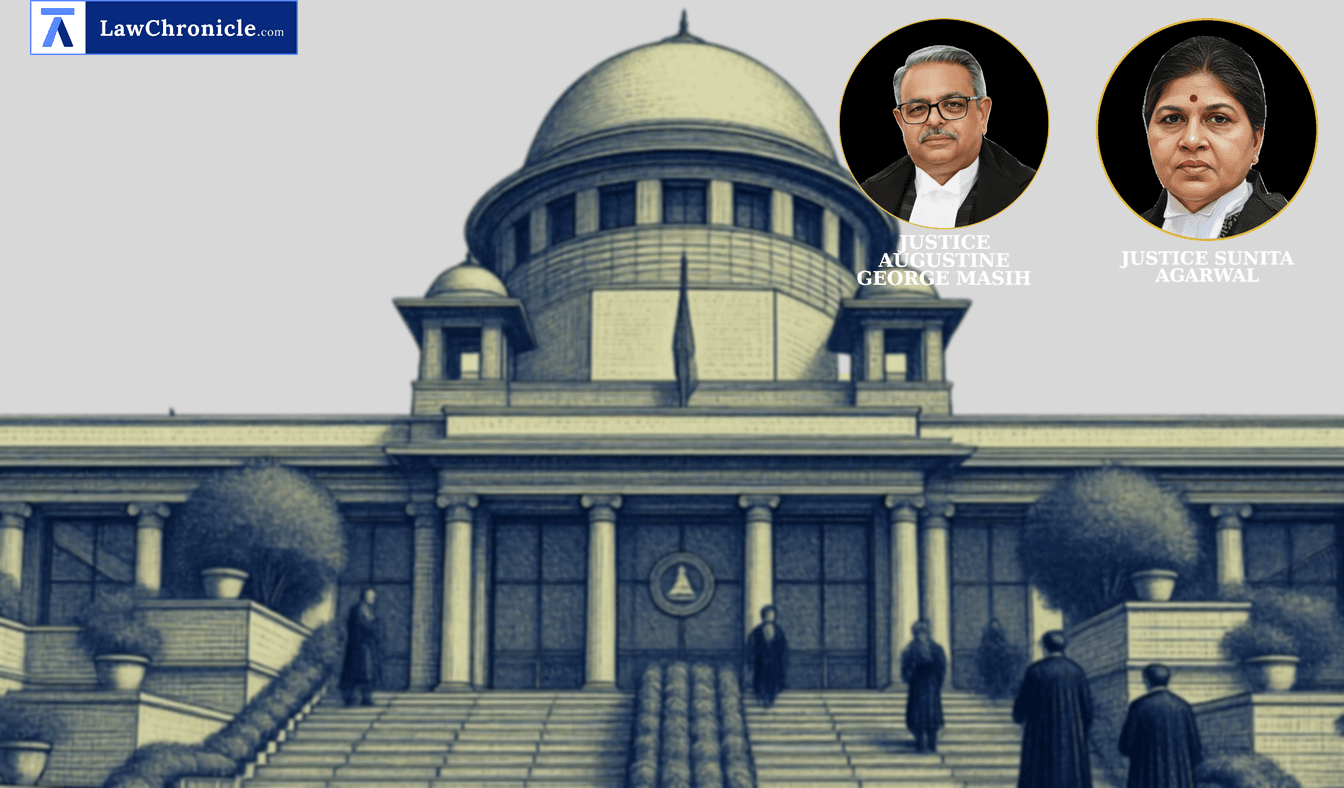
The Supreme Court has ruled that grandchildren hold no statutory right to demand a share in their living father's partitioned inheritance, as properties inherited under intestate succession immediately lose their ancestral coparcenary character to become absolute individual holdings. Cementing the primacy of codified law over traditional Hindu legal concepts, the Supreme Court held that a son's son is strictly excluded from Class I inheritance during the father's lifetime.
A bench comprising Justice Augustine George Masih and Justice Sunita Agarwal dismissed a civil appeal challenging a decision of the High Court, which had set aside a preliminary decree of partition granted in favor of a minor son seeking a half-share in property inherited by his living father.
Key Takeaways
Exclusion of Living Son's Son: Section 8 of the Hindu Succession Act, 1956 excludes a living son's son from Class I heirs, conferring absolute individual ownership on the son.
Eradication of Coparcenary Character: Once ancestral property is partitioned among Class I heirs, it ceases to be joint family property and cannot be claimed as coparcenary property by subsequent descendants by birth.
Validity of Alienation: Since a father holds partitioned inherited property as an absolute owner, he possesses full legal authority to alienate the property without his children's consent.
Intestate Succession and Coparcenary Rights
The Supreme Court observed that under Section 8 of the Hindu Succession Act, 1956, the scheme of intestate succession confers absolute ownership on specified Class I heirs. The bench emphasized that the codified law deliberately excludes the son of a living son from Class I, meaning such a grandson acquires no rights by birth over property that devolves upon his father. The Bench noted that "In the codified Hindu Law of the Hindu Succession Act, 1956, the right of a son’s son in his grandfather’s property during the lifetime of his father which existed under the personal Hindu Law as enforced before the Act 1956, was not saved expressly by the legislature while enacting the Hindu Succession Act, 1956. Section 8 of the Hindu Succession Act, 1956 is to be read as a self-contained provision laying down the scheme of devolution of the property of the Hindu male dying intestate."
Addressing the state amendment arguments, the Apex Court held that neither Section 6 of the Hindu Succession Act, 1956 nor Section 29-A of the Hindu Succession (Tamil Nadu Amendment) Act, 1989 applied to the case, as the succession opened prior to the appellant's birth and the joint coparcenary did not survive after the partition.
Ratio
Under Section 8 of the Hindu Succession Act, 1956, property inherited by a male Hindu from his intestate father is held in his individual capacity as an absolute owner and not as Karta of a Hindu Undivided Family. Consequently, a son born after the succession/partition acquires no right by birth in such property during the lifetime of his father.
Background
The dispute originated from a suit for partition filed in 1997 on behalf of the minor appellant by his mother, claiming a half-share in an 1811 sq. ft. property. The suit property originally belonged to the minor's grandfather, N. Ramakrishnan. Following a partition suit filed in 1993 by the grandfather's daughter, a compromise decree was passed on February 3, 1994, allotting the subject land to the minor's father as his divided share. Subsequently, in April 1997, the father sold the property via registered sale deeds to third-party purchasers.
The minor appellant, who was born on January 6, 1994, contended that he became a coparcener by birth in the ancestral property and challenged his father's right to alienate the land without his consent. Reliance was placed on Section 29-A of the Hindu Succession (Tamil Nadu Amendment) Act, 1989 and judicial precedents including Rohit Chauhan Vs. Surinder Singh and others ( "(2013) 9 SCC 419": 2013 CaseBase(SC) 75) and Arshnoor Singh Vs. Harpal Kaur ( "(2020) 14 SCC 436": 2019 CaseBase(SC) 1894) to argue that partitioned ancestral property retains its coparcenary nature vis-a-vis the allottee's son.
Conversely, the respondents relied on landmark precedents such as C.W.T. and others Vs. Chander Sen and others, Vimalben Ajitbhai Patel Vs. Vatslabeen Ashokbhai Patel and others ( "(2008) 3 SCC 87": 2008 CaseBase(SC) 1594), Radha Bai Vs. Ram Narayan and others ( "(2020) 19 SCC 513": 2019 CaseBase(SC) 3577), and Yudhisthir Vs. Ashok Kumar to contend that under Section 8 of the Hindu Succession Act, 1956, inherited property becomes self-acquired individual property in the hands of the divided son, entirely excluding the grandson.
While the Trial Court had passed a preliminary decree for partition, the First Appellate Court and the High Court set it aside. The Supreme Court upheld the High Court's view, ruling that upon partition, the joint family character came to an end and the father became the exclusive owner, leaving the minor son with no right to demand partition.
Case Details:
Case No.: Civil Appeal No. 7020 of 2012
Neutral Citation: 2026 INSC 1208
Case Title: J. Rajesh (Minor) Thr. His Mother And Natural Guardian J. Gomathi v. M. Kumaran (Dead) Thr. LRs. & Ors.
Appearances:
For the Petitioner(s): Mr. K. Paari Vendhan, Advocate
For the Respondent(s): Mr. K.K. Mani, Advocate
Source: 2026 CaseBase(SC) 10280
 Breaking News


