


Madras HC: Writ Against Private Banks for Private Debt Recovery Not Maintainable Under Article 226
 Copy Link
 Share
 Save
Private financial institutions enforcing contractual rights under the SARFAESI Act remain outside the ambit of writ jurisdiction, as they do not discharge public functions while recovering private debts. In a firm clarification of constitutional boundaries, the High Court has ruled that a writ petition is not maintainable against a private bank merely because it initiates recovery proceedings under statutory frameworks.
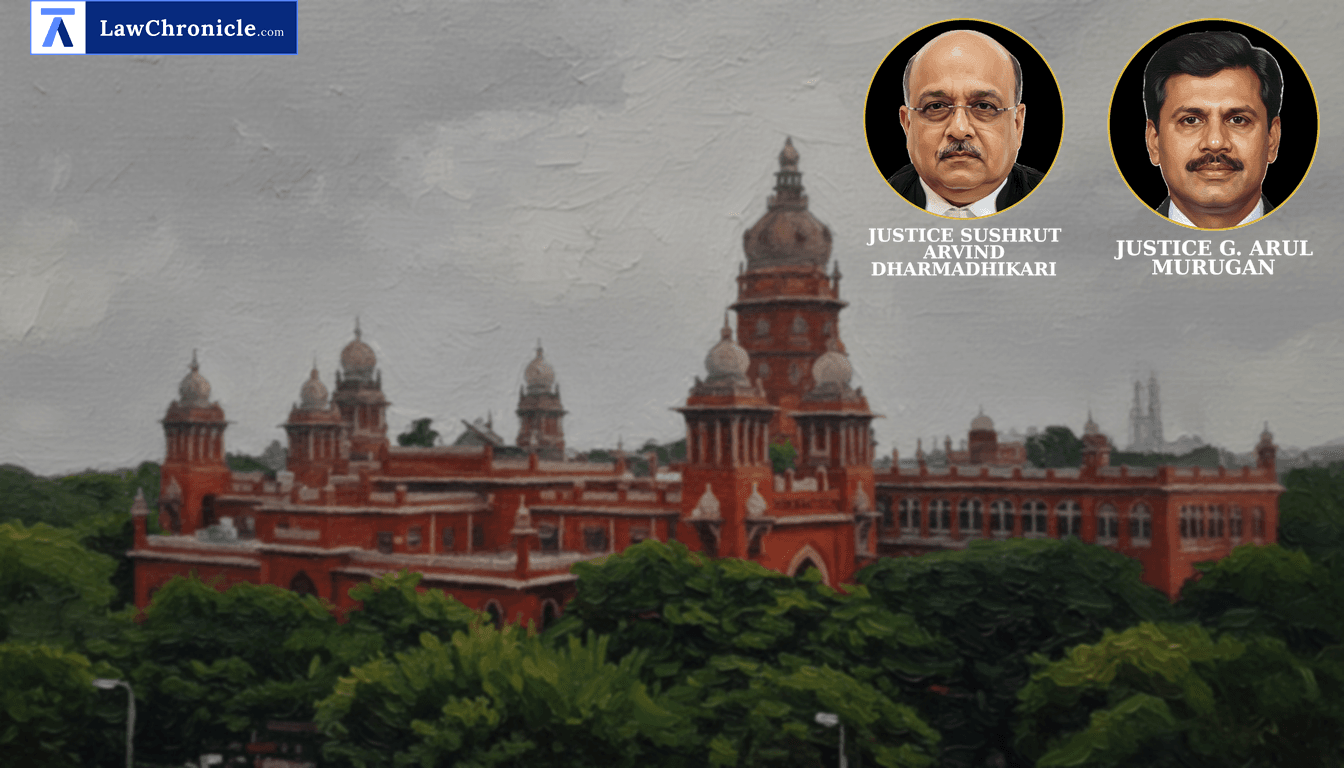
A Division Bench comprising Chief Justice Sushrut Arvind Dharmadhikari and Justice G. Arul Murugan heard the challenge against a possession notice issued by a private housing finance company. The Court examined whether a private lender could be considered 'State' or an 'instrumentality of the State' for the purpose of judicial review under the Constitution of India.
Recovery Actions by Private Lenders Not Public Functions
The Court observed that the second respondent, a private housing finance entity, was merely enforcing a private contractual right and security interest created by the borrower. It held that such actions do not amount to discharging sovereign duties or public functions. The Bench relied on the precedent set in Phoenix ARC (P) Ltd. v. Vishwa Bharati Vidya Mandir ( "(2022) 5 SCC 345": 2022 CaseBase(SC) 661), which established that a writ petition against a private financial institution/ARC under the Constitution of India against proposed actions under the SARFAESI Act is not maintainable.
The Court, in its reasoning, observed: "The ARC as such cannot be said to be performing public functions which are normally expected to be performed by the State authorities. During the course of a commercial transaction and under the contract, the bank/ARC lent the money to the borrowers herein and therefore the said activity of the bank/ARC cannot be said to be as performing a public function which is normally expected to be performed by the State authorities."
Bar of Alternative Efficacious Remedy
Even on the assumption of maintainability, the Court noted that the petitioner failed to utilize the specific grievance redressal mechanism provided under the law. Citing the Supreme Court's 'epoch-making' judgment in PHR Invent Educational Society v. UCO Bank ( "(2024) 6 SCC 579": 2024 CaseBase(SC) 62), the Bench emphasized that High Courts should decline jurisdiction when an effective alternative remedy exists. Under Section 17 of the SARFAESI Act, aggrieved persons must approach the jurisdictional Debts Recovery Tribunal rather than the High Court.
The Court has following directions:
"In light of the above, we are of the view that the present writ petition is not maintainable and, therefore, the same is dismissed. There shall be no order as to costs. Consequently, connected miscellaneous petitions are closed."
Key Takeaways:
Limited Scope of Article 226
Writs against private bodies are restricted to instances where they discharge a public duty or statutory public function, excluding commercial debt recovery.
Contractual Enforcement Rights
Private banks enforcing security interests under the SARFAESI Act are exercising private contractual rights, not sovereign state powers.
Statutory Remedy Supremacy
Constitutional courts will generally respect the specialized forum of the Debts Recovery Tribunal for all grievances arising from SARFAESI Act measures.
Ratio Decidendi:
A writ petition under Constitution of India is not maintainable against a private bank or financial institution enforcing a private debt or security interest under the SARFAESI Act, as such actions do not constitute the discharge of a public function or sovereign duty. Furthermore, where a statute provides a specific mechanism for grievance redressal, the High Court must decline to entertain a writ petition due to the availability of an alternative efficacious remedy.
Background:
The petitioner, J. Pandiyammal, approached the High Court seeking a writ of certiorari to quash a possession notice dated November 17, 2021, issued by Edelweiss Housing Finance Limited. The petitioner alleged the notice was arbitrary and illegal. However, no one appeared for the petitioner during the hearing. The Court took up the matter to decide on the threshold question of maintainability, concluding that the respondent was a private entity and the petitioner had a statutory remedy available before the DRT. Consequently, the writ petition was dismissed.
Case Details:
Case No.: W.P.No.14815 of 2025
Case Title: J.Pandiyammal v. The Reserve Bank of India and another
Source: 2026 CaseBase(MAD) 350
Similar Articles



 Breaking News


