


Senior Officers Liable for Indirect Bribery Through Subordinates: SC
 Copy Link
 Share
 Save
The Supreme Court has set a significant precedent by clarifying that a public servant can be held liable for bribery under the anti-corruption law even if the undue advantage is sought for another person or through third parties, effectively closing a loophole used by senior officials to maintain deniability while orchestrating corruption.
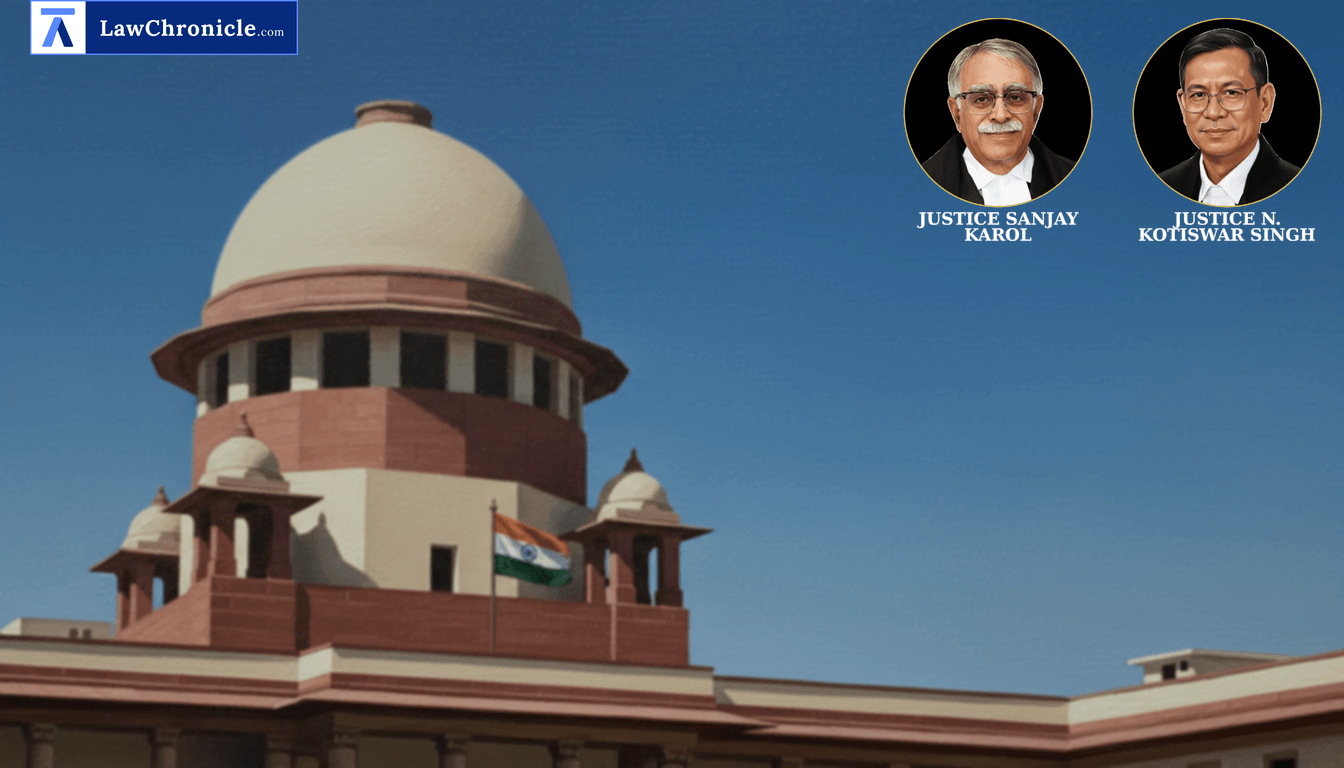
A bench comprising Justice Sanjay Karol and Justice Nongmeikapam Kotiswar Singh allowed an appeal filed by the Lokayukta Police against a High Court order that had quashed an FIR against a Police Sub-Inspector. The Apex Court scrutinized the expansive nature of Section 7 of the Prevention of Corruption Act, 1988, emphasizing that an 'attempt to obtain' a bribe is as culpable as the actual receipt of one.
Interpretation of Section 7 and the Scope of Indirect Corruption
The Court observed that the High Court erred by requiring a direct and personal demand for the investigation to proceed. The bench highlighted that under Section 7(a) read with Explanation 2 of the Prevention of Corruption Act, 1988, the law covers cases where a public servant attempts to obtain an advantage for himself or for 'another person' through subordinates or intermediaries.
Redefining 'Demand' and 'Attempt' Under Anti-Corruption Law
The Court, in its reasoning, observed: "The PC Act does not countenance any such straitjacketed formulation limiting to acts of demand and acceptance of bribe by the official himself as explained by expansive provision of Explanation 2. It can be for obtaining the undue advantage 'for another person' also. Further, an attempt to obtain a bribe through subordinates who are also public servants, is precisely the kind of indirect corruption that the legislature, by enacting Explanation 2 to Section 7, has sought to bring within the fold of the statute."
Furthermore, the Court clarified that actual exchange of money is not a prerequisite for prosecution. The Court has following directions:
"The impugned Judgment and Order dated 23.01.2024 passed by the High Court of Karnataka at Dharwad in Writ Petition No. 104236 of 2023 is hereby set aside. FIR bearing Crime No. 04/2023 dated 03.06.2023 registered against Respondent No. 1 under Section 7(a) of the Prevention of Corruption Act, 1988 and all proceedings arising therefrom, stand revived and restored and the trial court to proceed in accordance with law."
Background:
The case originated from a complaint against a Police Sub-Inspector (PSI) in Bellary District. It was alleged that the PSI seized the complainant's vehicle and mobile phone, later directing him to "do something for those boys" (referring to his subordinates) to get the items released. Subsequently, a Constable (Accused No. 2) demanded a bribe of Rs. 5,000.
The High Court of Karnataka had quashed the FIR on the grounds that there was no direct demand or acceptance by the PSI. However, the Supreme Court noted that the High Court had conducted a "mini-trial" at the quashing stage, which is impermissible under Section 482 of the Code of Criminal Procedure, 1973 (now CrPC). The Court relied on principles from State of Haryana v. Bhajan Lal ( "1992 Supp (1) SCC 335": 1990 CaseBase(SC) 91) regarding the limited scope of quashing powers and referred to the legal proposition in Devinder Kumar Bansal v. State of Punjab that mere solicitation amounts to an offence. The Court also distinguished post-trial judgments like K. Shanthamma v. State of Telangana, Soundarajan v. State, and Jagtar Singh v. State of Punjab ( "(2023) 19 SCC 498": 2023 CaseBase(SC) 279), noting they apply to the standard of proof for conviction, not the threshold for investigation.
Case Details:
Case No.: CRIMINAL APPEAL NO(s). OF 2026 (@ SLP (CRL.) NO.5245 of 2025)
NeutralCitation: 2026 INSC 574
Case Title: THE STATE BY LOKAYUKTHA POLICE vs. SRI K. RANGAYYA & ANR.
Source: 2026 CaseBase(SC) 485
Similar Articles
 Breaking News


