


Writ Not Remedy For Unpaid Professional Fee Claims Against Banks: Madras HC
 Copy Link
 Share
 Save
Public law remedies cannot be weaponized as debt recovery mechanisms for professional legal fees, as the Madras High Court reaffirmed that contractual disputes involving disputed facts and service deficiencies fall outside the ambit of extraordinary writ jurisdiction. The Court emphasized that an attorney-client fee dispute, especially when marred by allegations of administrative malice and service failures, must be adjudicated through a regular civil trial rather than a summary constitutional proceeding.
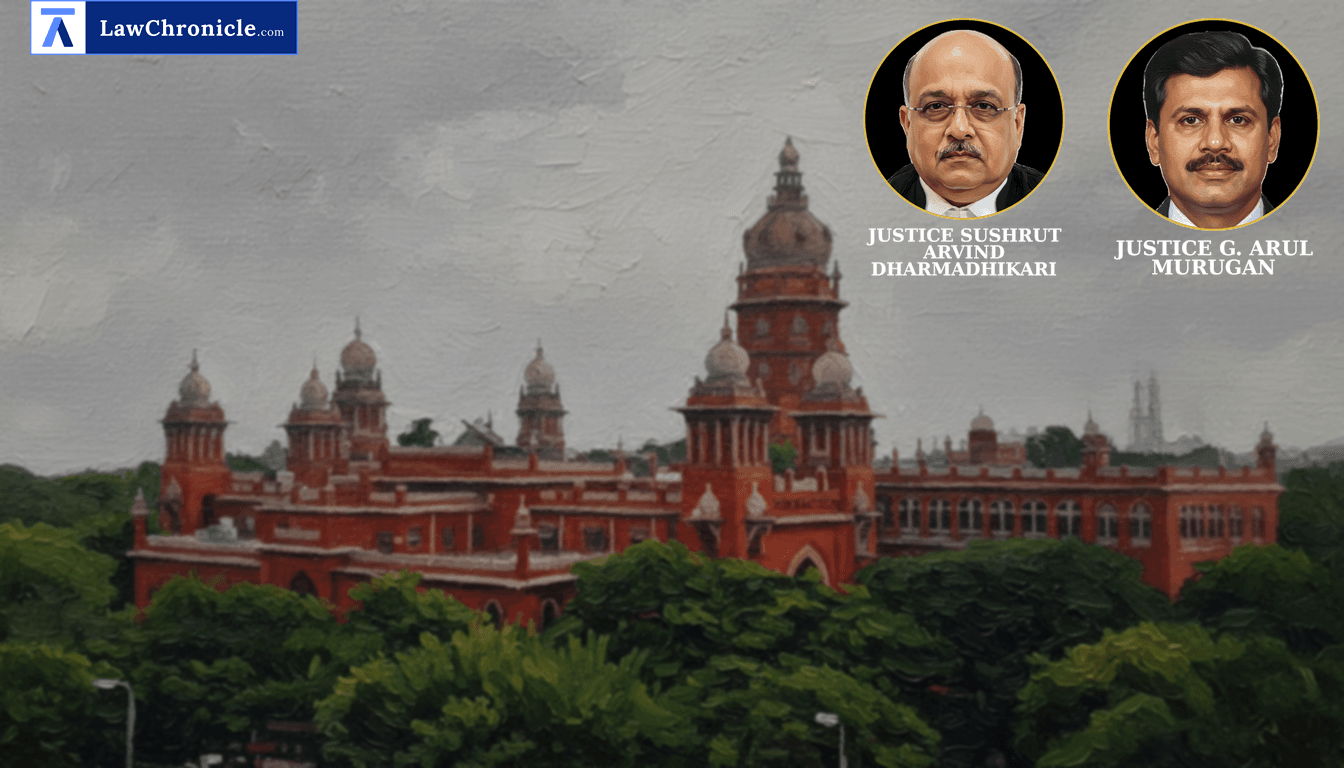
A Division Bench comprising Chief Justice Sushrut Arvind Dharmadhikari and Justice G.Arul Murugan heard an appeal filed by an advocate against a Single Judge's refusal to intervene in his claim for outstanding professional dues from Punjab National Bank. The appellant, who served as an empanelled counsel, had sought a direction for payment of over Rs. 10 Lakhs, alleging that bank officials had demanded a 40% commission to release his legitimate dues.
Writ Jurisdiction Not an Alternate Recovery Mechanism
The Court clarified that the power under Article 226 of the Constitution is a specialized public law remedy meant for correcting constitutional overreach and not for enforcing commercial contracts. It observed that the bank, while being an instrumentality of the State under Article 12 of the Constitution, cannot be subjected to a writ for professional fees when the underlying facts regarding service quality are contested.
Court Observations on Contractual Scrutiny
The Bench noted that the bank had explicitly raised issues regarding the performance of services, which transitioned the matter from the public law domain to the realm of private civil obligations. The Court, in its reasoning, observed: "For a court to step into the realm of contract under writ jurisdiction, the appellant must demonstrate an absolute, unambiguous admission of liability by the respondent, coupled with shocking arbitrariness that offends the sense of justice under Article 14 of the Constitution of India of the Constitution of India. When the respondent/bank raises questions regarding the performance of a service, the matter loses its public law character and enters the domain of private civil obligations."
The Court has the following directions:
"The appeal is hereby dismissed and the impugned order of the learned Single Judge is affirmed. The appellant is granted liberty to establish his claims for professional fees and agitate his grievances before a competent civil court or appropriate forum. If the appellant chooses to file a civil suit, the time spent bona fide prosecuting the writ petition and this writ appeal shall be excluded for the purpose of computing limitation."
Key Takeaways:
Public Law Boundary Reaffirmed
Professional fee disputes between advocates and State-owned banks are primarily contractual and do not warrant constitutional intervention unless there is an unambiguous admission of liability.
Exclusion of Limitation Periods
Litigants who erroneously pursue writ remedies for contractual claims are protected by the Court's direction to exclude the time spent in such 'bona fide' litigation from limitation periods for future civil suits.
Necessity of Regular Trials
Allegations of corruption, bribery, or service deficiency in legal billing require the recording of evidence and cross-examination, which are exclusive functions of a civil court.
Ratio Decidendi:
Article 226 of the Constitution is an extraordinary public law remedy and cannot be utilized as an alternative recovery mechanism for professional or commercial contracts where the liability is not admitted and the facts are in dispute. Such matters belong to the domain of private civil law, requiring adjudication by a competent civil court through a regular trial.
Background:
The appellant, a former empanelled advocate for Punjab National Bank, initially filed a writ petition seeking payment of Rs. 6,80,412/-, later enhanced to Rs. 10,00,628/-, as unpaid professional fees. He alleged the bank's non-payment was due to administrative malice. Conversely, the bank argued that the claims were disputed due to service deficiencies. The learned Single Judge dismissed the petition on April 18, 2024, holding that extraordinary writ jurisdiction was inappropriate for resolving such disputes. The Division Bench affirmed this view, noting that the appellant had "knocked on the wrong judicial door."
Case Details:
Case No.: W.A.No.1750 of 2024
Case Title: Sunit Kumar Agarwal v. The Asst. General Manager, Punjab National Bank and Others
Appearances:
For the Petitioner(s): Mr.Sunit Kumar Agarwal (Appearing in person)
For the Respondent(s): Mr.P.Raghunath for M/s.T.S.Gopalan & Co
Source: 2026 CaseBase(MAD) 357
Similar Articles
 Breaking News


